
Freight invoice processing is how a team turns an incoming ocean freight invoice into a decision: pay it, reject it or dispute it. Done manually, it means checking every line against contracts, SLA rules and shipment timelines, and overcharges still slip through. This guide shows how to automate freight invoice processing, how to match, reject and dispute ocean invoices faster, and how audit by exception lets your team review only the charges that fail the checks. It also covers what implementation looks like, how to score your own maturity and where BCOs, forwarders and NVOCCs should start.
What Is Freight Invoice Processing, or Freight Bill Processing?
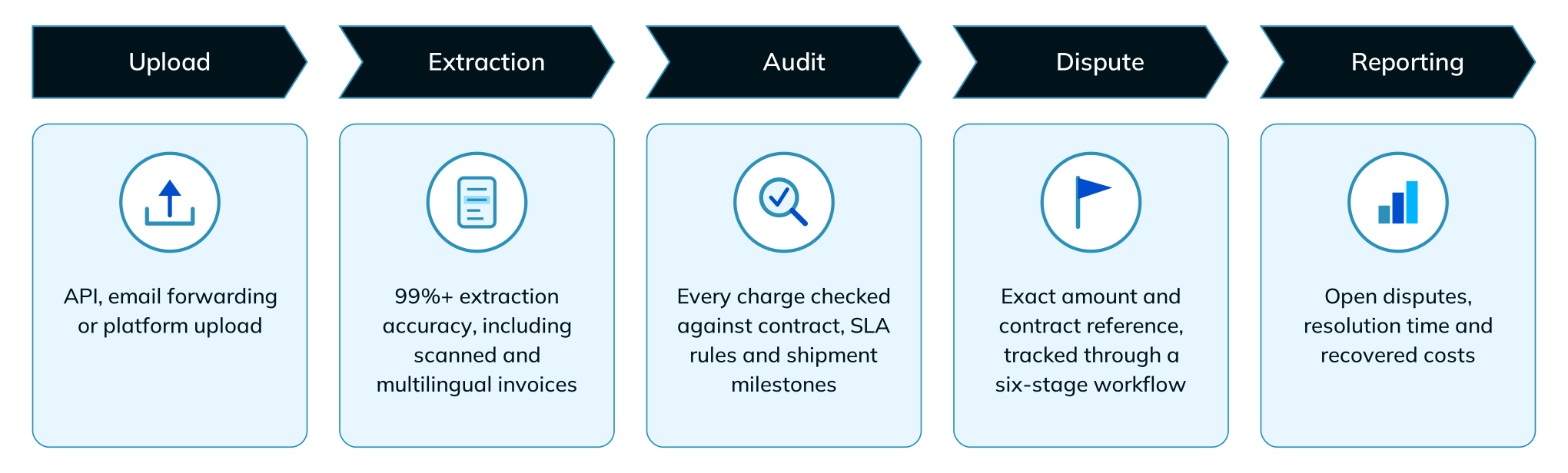
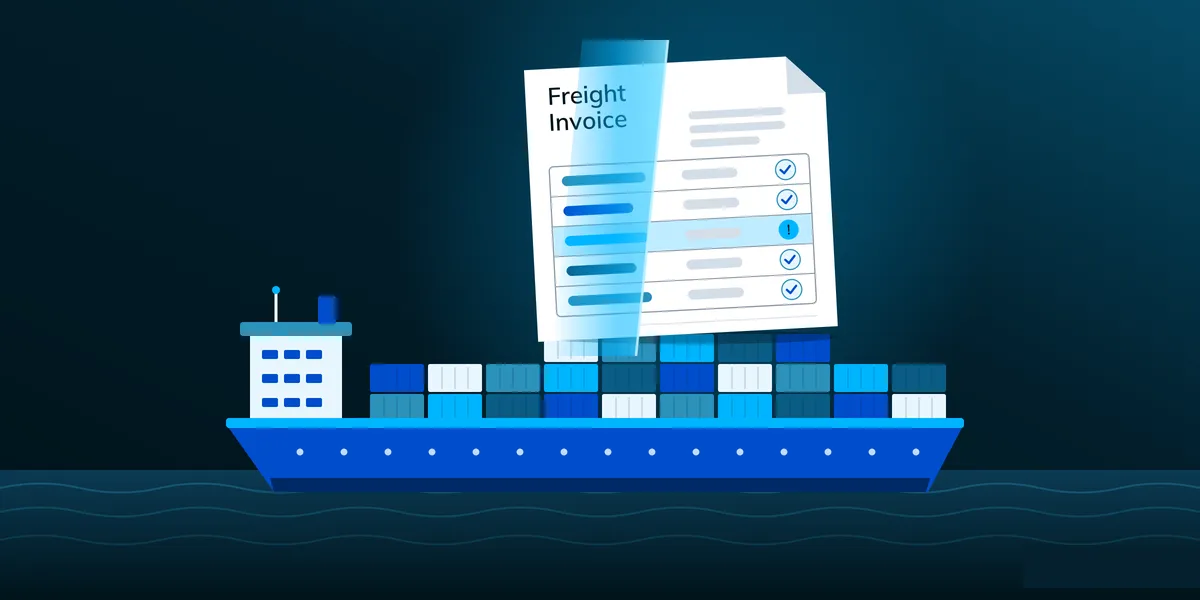
Freight invoice processing, also called freight bill processing, covers everything between a carrier sending an invoice and your team paying, rejecting or disputing it. For ocean freight, it has five stages: upload, extraction, audit, dispute, and reporting. Most teams still run these stages manually in spreadsheets, which is slow and lets overcharges through.
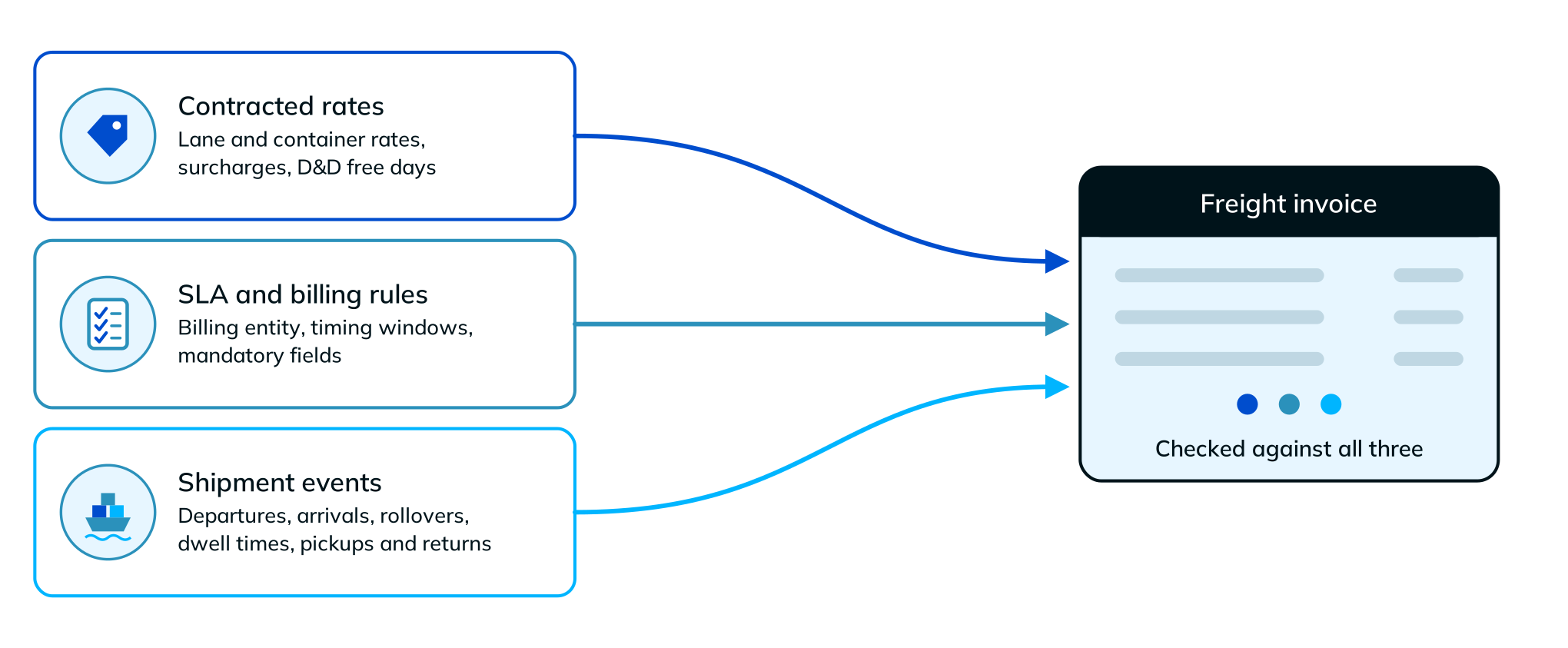
Every freight invoice has to line up with three sources: your contracted rates, your SLA and billing rules, and what actually happened on the shipment. Carriers invoice from their own records, so without cross-checking all three, a team largely takes the invoice at face value.
Why Does Manual Freight Invoice Processing Miss Overcharges?
A manual process usually runs like this: extract the line items into a spreadsheet, pull the contract and check the rate, check SLA rules if someone remembers, skip the shipment data because tracking sits in another system, then raise the dispute by email and follow up. At the volumes ocean freight teams handle, catching every error this way is not realistic, so teams audit a fraction of what arrives.
The leaks usually look like this:
How to Automate Freight Invoice Processing
Freight invoice processing automation covers every stage, from reading the contract to disputing what fails.
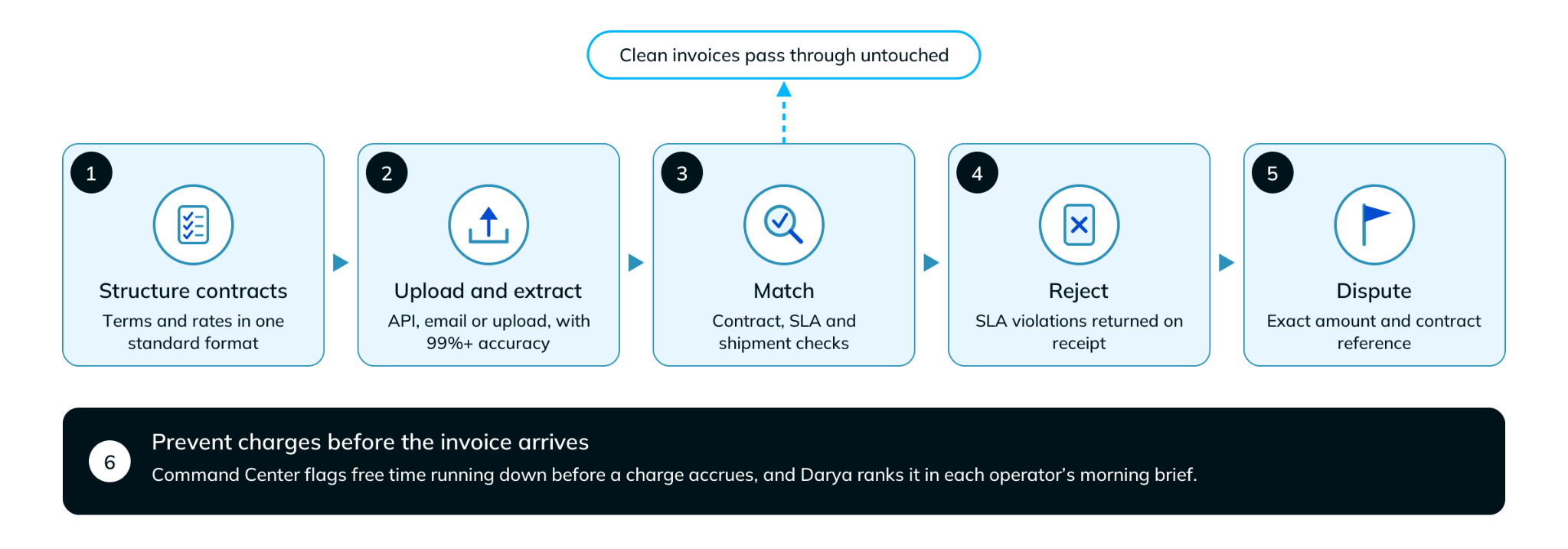
Structure your carrier contracts once
Portcast uses generative AI to extract the relevant terms and rates from carrier contracts and structure them in a standard format, whichever carrier wrote them. That structured version serves quoting, accruals and audit, so the interpretation happens once for the whole business and nobody keys a tariff in manually.
Upload and extract without re-keying
Connect your systems so invoices flow in and get audited without anyone touching them. Email forwarding and platform upload are available when you need them, and API access suits teams that want audit inside their own systems. Portcast’s freight audit software extracts structured data with 99%+ accuracy. The AI is trained on thousands of shipping documents from major ocean carriers, handles scanned, multilingual and non-standard layouts, and outputs clean data as JSON or Excel.
Match every charge with a freight invoice audit
Automated invoice matching compares each carrier invoice against the shipment record and checks every line, with no sampling. The freight invoice audit runs across three layers. A contract check confirms the rate for the lane, container type and period, accessorial charges within agreed terms and surcharges on current-period rates. An SLA check confirms the invoice went to the correct entity, arrived in the time window, carries the mandatory fields and separates charges correctly. A shipment event check asks whether a D&D charge was legitimate given what happened on the voyage, whether the delay was carrier-caused and whether the invoice shows the right number of chargeable days. Clean invoices pass through untouched, and finance time moves onto exceptions. Matching also supports a faster month-end close, and invoicing accuracy by carrier becomes part of the carrier scorecard.
Reject ocean invoices faster by enforcing SLA rules
Most BCOs negotiate detailed invoice compliance rules into carrier contracts, covering billing entities, timing windows, charge separation, mandatory fields and tax treatment. In practice, very few companies check all of these on every invoice. Portcast ingests the full SLA rule set and validates every invoice on receipt. An SLA violation is grounds for an outright dispute, even when the rates are correct, so your team can reject a non-compliant invoice on the day it arrives.
Dispute overcharges faster with audit by exception
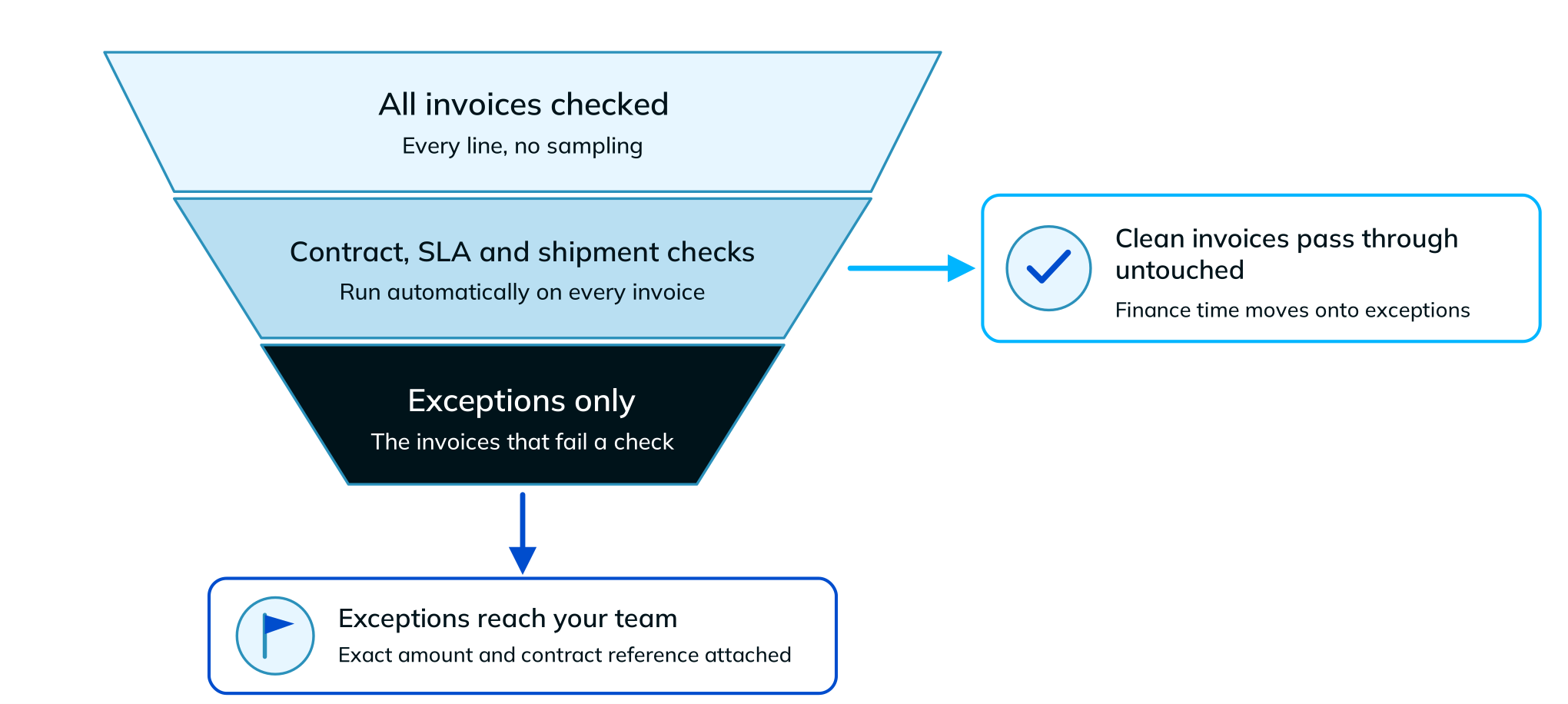
The fastest way to dispute is to stop checking every invoice yourself. Audit by exception means the system checks every invoice and your team reviews only the ones that fail a check. The work shifts to the carrier, who has to answer for each flagged charge. The dispute starts from the finding, so nobody rebuilds the case, and every rejection goes to the carrier in the same format with the same evidence. Every flagged charge comes with the exact amount in question and the relevant contract reference. Your policy thresholds are applied the same way on every invoice, so what gets disputed does not depend on who opened it or how busy they were. Dispute packages and audit trails flow into a tailored six-stage workflow with an owner at each stage, and findings feed back into SAP or your ERP. Dashboards show dispute status and ageing, so nothing is quietly written off, and recovery totals over a period show the financial impact.
Prevent charges before the invoice arrives
The audit does not have to wait for the invoice. Portcast monitors live shipments against contracted D&D terms, so exposure shows up before it becomes a charge. In one published example, a container had 14 combined free days from empty pickup, and 11 had elapsed, leaving 3 before D&D began. Command Center flagged the risk, the team confirmed with the carrier before the window closed, and the charge never accrued. Darya, the Daily AI Agent, brings the same signal into each operator’s morning brief. Containers with free time running down, and those already incurring charges, are ranked with a suggested next step, such as booking a haulier pickup or requesting a free-time extension. Your team approves each action.
Freight Invoice Processing Automation: What Does Implementation Look Like?
Implementation follows how invoices already move through your business.
- Contracts. Terms and rates are extracted and structured once, and your full SLA rule set is ingested alongside them.
- Intake. Invoices arrive through API, email forwarding or platform upload.
- Shipment data. Evidence comes from Portcast visibility, or from your own TMS or internal systems through integration. Audit quality is the same either way.
- Back-integration. Findings flow into SAP or your ERP, so nothing is re-entered and disputes do not sit in a parallel tracker.
- Rollout. A global F&B company went live in three regions in six weeks.
- Learning loop. Invoices that need manual review feed a loop that continuously improves the model.
How Mature Is Your Freight Audit Process?
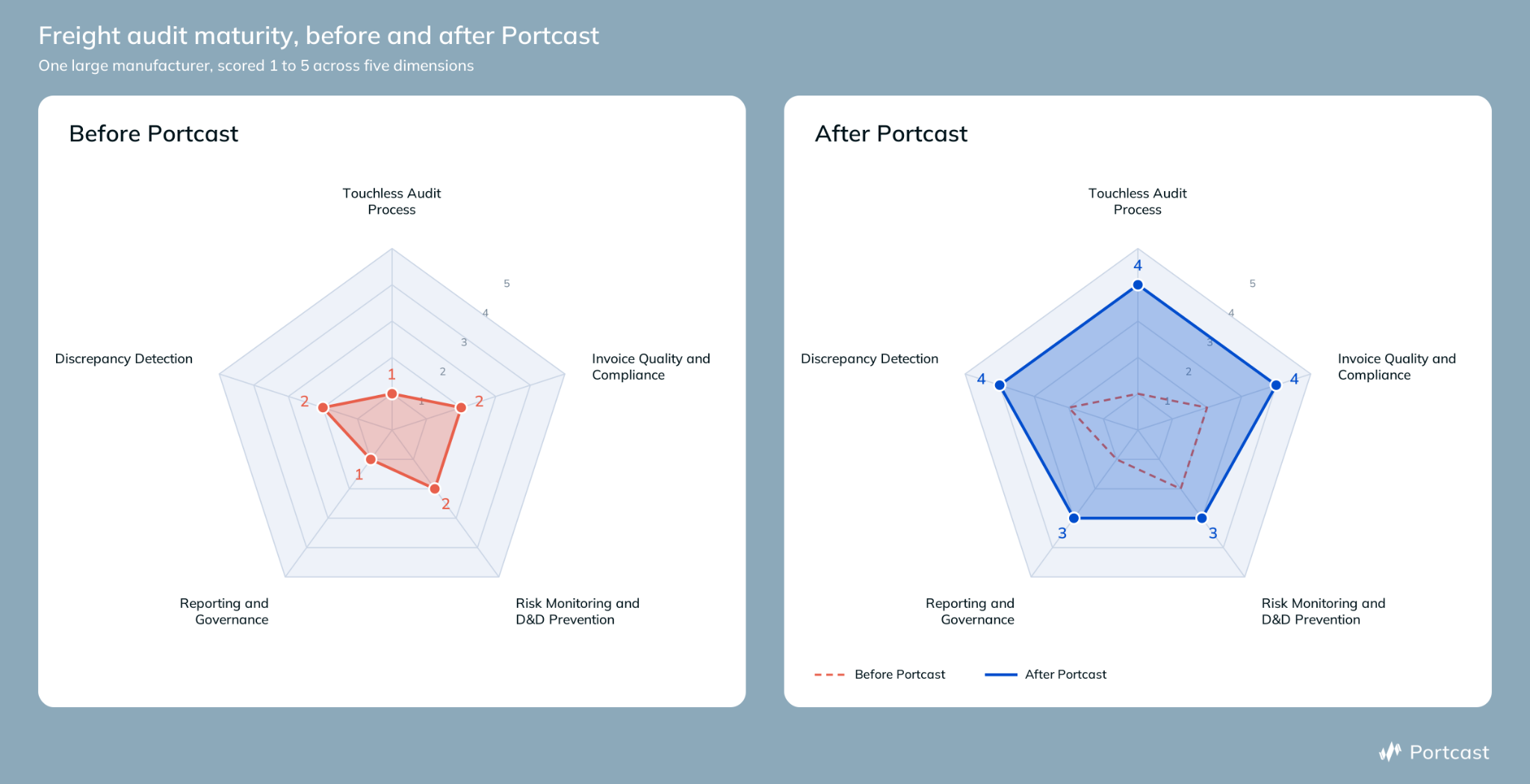
Portcast assesses customers across five dimensions when they start. Score your own process from 1 to 5 on each, using these questions. Most large BCOs, including ones with serious freight spend, score low on at least three of them at the start.
- Invoice quality and compliance: Do your carriers invoice consistently, on time and to the correct entity? Are there agreed SLA rules, and are they enforced on every invoice?
- Touchless audit process: Is your audit touchless, or are people manually extracting data from PDFs and cross-checking spreadsheets? How much of your invoice volume actually gets audited?
- Discrepancy detection: Do you identify disputes against contract data only, or against actual shipment events too? Are rollover-caused D&D charges being challenged?
- Reporting and governance: Can you see audit performance, recovery rates and carrier billing behavior, and can procurement use this at contract renewal?
- Risk monitoring and D&D prevention: Are containers tracked live against contracted free days, and are D&D risks surfaced before charges accrue?
Take the freight audit maturity scorecard to score all five. As an example, one large manufacturer started at 1 or 2 out of 5 on almost every dimension: invoices reviewed manually, no SLA enforcement, no shipment data linked to the audit, no live D&D monitoring, and charges arriving as surprises. After rollout it reached 4 out of 5 on touchless audit process, discrepancy detection and invoice compliance, 3 out of 5 on reporting and governance and on risk monitoring, and about 5% of its total invoiced freight cost was recovered. Ask any provider for this kind of before-and-after mapping upfront.
Global Freight Invoice Processing: What Do the Results Look Like?
Customer story - BCO (Leading global F&B manufacturer)
- Touchless data extraction rose from 0% to 96.5%, and touchless invoice validation rose from 0% to 76%. Three regions went live in six weeks.
- Across 20+ carriers, every invoice was audited across all regions with no manual data extraction. About 50% of invoices contained at least one SLA or contract-level discrepancy, and 95%+ of flagged discrepancies were validated as legitimate disputes by the customer team.
- Savings came to about 5% of the invoiced cost, and a disproportionate share of contract-level billing errors came from a small number of carriers.
- Audit time cut by up to 10X as audits move from days to minutes.
Customer story - Freight forwarder
A global forwarder operating in more than 50 countries and moving around 200,000 containers a year approved and rejected carrier invoices manually across Operations and Finance. Modelled on its own volumes and spend, Portcast Freight Audit represents over €11m in annual value:
- Efficiency: about €1.6m, based on 400,000 invoices a year at 15 minutes each, a blended cost of around €20 an hour and an 80% reduction in processing time.
- Overpayment reduction: about €4.0m, based on around €400m of ocean freight spend with 1% recovered, which is a conservative estimate of cost leakage avoided.
- Working capital: about €5.5m freed, because paying accurately allows payment to be delayed by 5 days without breaching credit terms. At a 5% cost of capital, that capital is worth about €273k a year.
These are modeled figures for the forwarder and actual value varies with carrier mix, contract terms and total spend.
Where Should BCOs, Forwarders and NVOCCs Start?
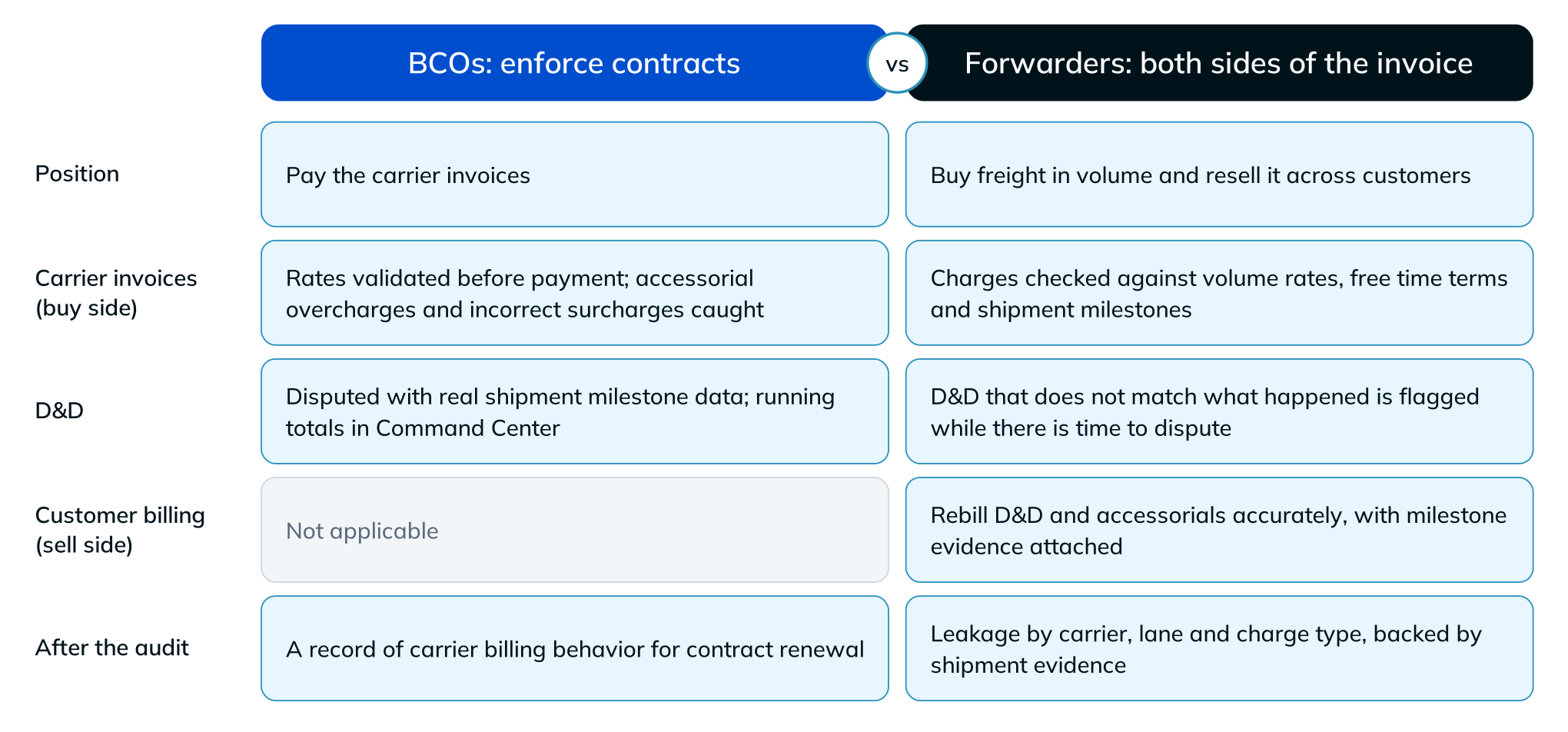
BCOs: enforce your contracts on every invoice
Check your contract terms on every invoice and validate rates before payment. Catch accessorial overcharges and incorrect surcharges before they are paid, dispute D&D using real shipment milestone data, and use D&D running totals in Command Center to see where cost is building before invoices arrive. Every dispute also builds a record of carrier billing behavior that you can use at contract renewal.
Freight forwarding invoice automation and ocean freight auditing software for NVOCCs
A forwarder buys freight in volume and resells it across customers, so contracts, rates and D&D terms are built around that structure. Portcast Freight Audit checks carrier charges against the volume rates and free time terms you negotiated and against actual shipment milestones, so overcharges, misapplied accessorials and D&D that do not match what happened are flagged while there is still time to dispute them. For freight forwarding invoice automation at book scale, reporting shows which carriers, lanes and charge types drive the most leakage, backed by shipment evidence you can take to the carrier. Contracted rates can also feed accruals and job costing through the API, so the financial file is built before the shipment arrives and the variance against the accrual is visible per job when the invoice lands.
Conclusion: Process Freight Invoices Faster by Auditing Exceptions
Freight invoice processing gets faster when every stage runs automatically and your team sees only the exceptions. Structure your contracts once, get invoices in without re-keying, match each charge to your contract and shipment record, reject non-compliant invoices on receipt, and dispute overcharges with evidence attached. To see how this works on your invoices, talk to our team.
Frequently Asked Questions
What is freight invoice processing?
Freight invoice processing is the work of receiving a carrier invoice, extracting its data, checking each charge against your contract and shipment record, and then paying, rejecting or disputing it. For ocean freight, the five stages are upload, extraction, audit, dispute and reporting. Automation handles the routine checks so your team reviews only exceptions.
How to automate freight invoice processing?
Get invoices in automatically through API, email forwarding or platform upload. Use AI that reads scanned, multilingual and non-standard invoices, then check every charge against contract terms, SLA rules and shipment milestones. Route only flagged exceptions to your team, with the exact amount and contract reference attached, and track each dispute to recovery.
What does a freight invoice audit check?
A freight invoice audit checks rates and accessorial charges against your contract, SLA rules such as billing entity, timing windows and mandatory fields, and D&D against what actually happened on the shipment. It finds charges above contracted rates, duplicate charges, outdated surcharges and delays that a carrier caused.
What is audit by exception in freight audit?
Audit by exception means a system checks every invoice and your team reviews only the ones that fail a check. Each flagged charge carries the exact amount in question and the relevant contract reference, so your team can send the dispute to the carrier without rebuilding the evidence.
Is there freight forwarder invoice processing software for forwarders and NVOCCs?
Yes. Portcast Freight Audit validates carrier invoices for freight forwarders as they arrive, checking each charge against your volume rates, free time terms and actual shipment milestones, so overcharges are flagged while there is still time to dispute them. Talk to the team about your carrier mix and how your buy and sell work.