Moving off SeaRates? Switch seamlessly |
Navigate ocean supply chain terms with ease using our alphabetical listing of terms and expressions connected with logistics, supply chains, ports, and cargo transportation
Transit time is the total amount of time it takes for a shipment to travel from its origin to its destination, typically measured from pickup (or vessel departure) to final delivery (or arrival).
A terminal handling charge (THC) is a fee levied by port terminals to cover the cost of handling a container, loading, unloading, and moving it within the terminal, at both the origin and destination port.
A spot rate is the price to move a shipment on the open market at a given point in time, negotiated for a single shipment rather than committed to under a longer-term contract.
Port congestion occurs when the volume of vessels, containers, or cargo at a port exceeds its capacity to process them efficiently, resulting in delays for vessel berthing, container unloading, and cargo pickup.
Per diem, in a shipping context, refers to the daily fee charged when a container is kept beyond its allotted free time, either sitting at the terminal (demurrage) or in use outside the terminal (detention).
Overcharge recovery is the process of identifying freight invoices where a carrier billed more than the contracted or correct rate, and recovering that excess amount as a refund or credit.
A minimum quantity commitment (MQC) is a contractual obligation where a shipper agrees to ship a minimum volume of cargo with a carrier over a set period, typically in exchange for a negotiated contract rate.
The last free day (LFD) is the final day a shipper or consignee can pick up an import container from the terminal (or return an empty container) before demurrage or detention charges begin accruing.
Invoice reconciliation is the process of comparing an invoice against supporting records, such as a purchase order, contract, or proof of service, to confirm the billed amount and details are accurate before payment.
Freight audit is the process of systematically reviewing carrier freight invoices against contracted rates, accessorial charges, and shipment details to identify billing errors before or after payment.
Free time, or free days, is the number of days a shipper or consignee can keep an import container at the port terminal or use it outside the terminal before demurrage or detention charges begin to apply.
A contract rate is a pre-negotiated freight rate that a shipper and carrier agree to for a fixed period, typically covering a defined lane, volume commitment, and service level.
Container rollover (or "rolled cargo") occurs when a container that was booked on a specific vessel is not loaded onto that ship and is instead pushed, or "rolled," to a later sailing.
A carrier scorecard is a structured report that tracks and rates a carrier's performance against a defined set of metrics, such as on-time delivery, claims rate, and responsiveness, over a given period.
Carrier allocation is the practice of distributing a shipper's freight volume across multiple carriers according to a predetermined split, rather than relying on a single carrier for all shipments.
Accessorial charges are additional fees carriers charge on top of the base freight rate for services beyond standard pickup and delivery, such as liftgate service, inside delivery, residential delivery, or waiting time.
A Yard Management System (YMS) is software that tracks and coordinates the movement of trailers, containers, and trucks within a facility's yard, from gate check-in through dock assignment to departure.
Yard management is the coordination of trailers, containers, and trucks moving through a facility's yard, the outdoor area around a warehouse or distribution center, managing arrivals, dock assignments, and departures.
Volumetric weight, also called dimensional weight, is a pricing calculation used by carriers that estimates a shipment's weight based on its size (volume) rather than its actual physical weight, used to charge appropriately for bulky, lightweight packages.
A trade tariff is a tax imposed by a government on imported (or, less commonly, exported) goods, typically calculated as a percentage of the goods' declared value.
Trade compliance is the practice of ensuring that a company's import and export activities follow all applicable laws and regulations, including customs rules, export controls, sanctions, and product-specific requirements.
Total landed cost is the complete cost of getting a product from its origin to its final destination, including the product cost, freight, insurance, customs duties, taxes, and any other fees incurred along the way.
A TEU, or Twenty-foot Equivalent Unit, is a standard unit of measurement based on the volume of a 20-foot shipping container. It's used across the ocean freight industry to measure vessel capacity, port throughput, and cargo volumes in a consistent way, regardless of the actual mix of container sizes involved.
Sustainable supply chain management integrates environmental and social responsibility considerations into supply chain decisions, sourcing, manufacturing, and logistics, alongside traditional cost and performance factors.
Supply chain refers to the entire network of organizations, activities, and resources involved in creating and delivering a product, from raw materials to the end customer. Logistics is a subset of that, focused specifically on the movement and storage of goods within the chain.
Supply chain visibility is the ability to track and access real-time information about products, shipments, and materials as they move from origin to destination, across every partner and mode of transport involved. It means knowing not just where a shipment is right now, but whether it's on schedule, and what to do if it isn't.
Supply chain risk management (SCRM) is the systematic process of identifying, assessing, and mitigating risks that could disrupt the flow of goods, information, or finances through a supply chain.
Supply chain resilience is a supply chain's ability to anticipate, absorb, and recover from disruptions, whether a port closure, a supplier failure, a natural disaster, or a geopolitical shock, without a prolonged loss of service or output.
Supply chain mapping is the process of identifying and documenting every entity involved in producing and delivering a product, not just direct tier-1 suppliers, but the suppliers of those suppliers, across multiple tiers back to raw materials.
Supply chain management (SCM) is the end-to-end coordination of everything involved in producing and delivering a product, sourcing raw materials, manufacturing, transportation, warehousing, and final delivery to the customer.
Supply chain intelligence refers to the data, analytics, and insights that give organizations a clear, actionable understanding of their supply chain's current state and likely future performance, going beyond raw data to inform actual decisions.
A supply chain disruption is any unplanned event that interrupts the normal flow of goods, information, or materials through a supply chain, ranging from minor delays to major, prolonged interruptions.
A supply chain digital twin is a virtual, continuously updated model of a physical supply chain, its facilities, transportation network, and inventory flows, used to simulate scenarios and predict outcomes without affecting real operations.
Supply chain analytics is the use of data analysis techniques to understand supply chain performance, identify patterns, and support better decision-making across sourcing, logistics, and operations.
Slot booking is the process of reserving space (a "slot") on a specific vessel voyage for a container shipment, confirming that the carrier will load that container on that sailing.
Section 301 tariffs are additional import duties imposed by the United States under Section 301 of the Trade Act of 1974, typically in response to trade practices the US government considers unfair, most notably applied to a wide range of Chinese-origin goods.
Scope 1, 2, and 3 are categories used to classify a company's greenhouse gas emissions based on the Greenhouse Gas Protocol: Scope 1 covers direct emissions from owned operations, Scope 2 covers emissions from purchased energy, and Scope 3 covers all other indirect emissions across the value chain.
A Request for Quotation (RFQ) is a document a buyer sends to suppliers to request specific pricing for clearly defined goods or services, used when requirements are well understood and the primary decision factor is price.
Reefer trucking is the transportation of temperature-sensitive goods using refrigerated trailers (reefers) equipped with their own cooling units, maintaining a specific temperature range independent of the outside environment.
The Red Sea crisis refers to a period of security threats to commercial vessels transiting the Red Sea and the Bab-el-Mandeb Strait, the approach to the Suez Canal, which led many major carriers to reroute vessels away from the Suez Canal entirely.
Predictive analytics in supply chain uses historical and real-time data, combined with statistical models and machine learning, to forecast future outcomes, such as shipment delays, demand levels, or equipment failures, before they happen.
A packing list is a shipping document that details the exact contents, packaging, and physical characteristics of a shipment, including item counts, weights, and dimensions of each package, used to verify shipment contents at various points in transit.
Ocean carrier alliances are cooperative agreements between major shipping lines to share vessel capacity, coordinate routes, and jointly operate services on major trade lanes, rather than each carrier running its own separate fleet on every route.
Multimodal visibility is the ability to track a shipment continuously as it moves across multiple transportation modes, ocean, air, rail, and road, within a single, connected view rather than separate, disconnected tracking systems for each leg.
Middle mile delivery is the segment of the supply chain between the first mile (origin to initial hub) and the last mile (final hub to customer), typically involving the movement of goods between warehouses, distribution centers, or regional hubs.
A Master Bill of Lading (MBL) is issued by the ocean carrier to the freight forwarder for the entire consolidated container shipment, while a House Bill of Lading (HBL) is issued by the freight forwarder to each individual shipper whose cargo is part of that consolidation.
Logistics intelligence is the use of data analytics and reporting to generate actionable insights about logistics performance, such as carrier reliability, cost trends, and route efficiency, to inform better operational and strategic decisions.
Logistics is the process of planning, executing, and managing the movement and storage of goods, from point of origin to point of consumption, to meet customer or business requirements.
A Letter of Indemnity (LOI) is a document in which one party agrees to compensate another for a specific loss or liability, commonly used in shipping to allow cargo release without presenting the original bill of lading.
Less Than Truckload (LTL) is a shipping method where multiple shippers' freight shares space on the same truck, with each shipper paying only for the portion of space and weight their shipment uses.
Last mile delivery is the final leg of a shipment's journey, from a local distribution center or hub to the end customer's door, and it's the last, and usually shortest, distance in a much longer supply chain journey.
A known consignor is a shipper that has been vetted and certified by aviation security authorities as meeting specific security standards, allowing their air cargo to bypass certain additional screening requirements applied to unknown shippers.
IoT (Internet of Things) in supply chain refers to the use of connected sensors and devices, attached to vehicles, containers, pallets, or products, to continuously collect and transmit data like location, temperature, humidity, and shock.
An inventory buffer strategy is the deliberate practice of holding extra inventory beyond immediate demand needs, as a cushion against supply chain uncertainty such as demand spikes, supplier delays, or transportation disruptions.
Intermodal transportation is the movement of freight using two or more transportation modes, such as rail, truck, and ocean vessel, without the cargo itself being handled or repacked when switching modes, typically because it stays within the same container.
The Carbon Intensity Indicator (CII) is a rating system introduced by the International Maritime Organization (IMO) that measures how efficiently a vessel transports cargo or passengers relative to the CO2 it emits, assigning each ship an annual efficiency rating from A (best) to E (worst).
An HS code (Harmonized System code) is a standardized numerical code used internationally to classify traded products for customs purposes. It's maintained by the World Customs Organization and used by virtually every country to determine duties, taxes, and regulatory requirements for imported and exported goods.
Hours of Service (HOS) refers to federal regulations governing how many hours a commercial truck driver can drive and work before being required to rest, designed to reduce fatigue-related accidents.
The Harbor Maintenance Fee (HMF) is a fee charged by the US government on imported cargo (and some domestic cargo) moving through US ports, used to fund harbor dredging and maintenance.
Green logistics refers to logistics practices designed to minimize the environmental impact of transportation, warehousing, and distribution, reducing emissions, waste, and resource consumption across the supply chain.
Geopolitical risk in supply chain refers to the potential for political events, conflicts, sanctions, or trade policy shifts between countries to disrupt sourcing, manufacturing, or transportation routes.
A General Rate Increase (GRI) is a broad, across-the-board increase in ocean freight rates implemented by carriers on a specific trade lane, typically announced with advance notice and applied to all shippers on that route.
Full Truckload (FTL) is a shipping method where a single shipment fills an entire truck trailer, either by volume or because the shipper has booked exclusive use of the trailer, as opposed to sharing space with other shippers' freight.
A fuel surcharge is an additional fee added to freight rates to account for fluctuations in fuel prices, allowing carriers to adjust for fuel cost changes without renegotiating base rates for every shipment.
FTL (Full Truckload) means a shipment uses an entire truck exclusively. LTL (Less Than Truckload) means a shipment shares truck space with other shippers' freight, with each shipper paying only for the space and weight they use.
Freight visibility is the ability to see the real-time location, status, and estimated arrival of freight shipments as they move through the supply chain, across any mode of transport.
A freight rate index is a benchmark that tracks average freight rates across specific trade lanes or globally over time, used by shippers, carriers, and analysts to gauge market pricing trends.
Freight class is a standardized classification system, the National Motor Freight Classification (NMFC), used to categorize LTL (less-than-truckload) freight based on characteristics that affect handling and shipping cost.
A freight broker is an intermediary that connects shippers who need to move freight with carriers (usually trucking companies) that have capacity to move it. The broker doesn't own trucks or take possession of the cargo, it arranges the transaction and takes a fee or margin for matching supply with demand.
A Free Trade Zone (FTZ) is a designated area, usually near a port or airport, where goods can be imported, stored, handled, manufactured, or re-exported without being subject to standard customs duties until they leave the zone for domestic consumption.
A Free Trade Agreement (FTA) is a treaty between two or more countries that reduces or eliminates tariffs and other trade barriers on goods traded between them.
First mile delivery is the initial leg of a shipment's journey, moving goods from the point of origin, a factory, farm, or supplier, to the first point in the logistics network, such as a warehouse, distribution center, or carrier hub.
The exporter of record is the party legally responsible for ensuring an export shipment complies with all export regulations of the origin country, including accurate documentation, licensing, and compliance with export control laws.
The EU Emissions Trading System (ETS) is the European Union's carbon pricing mechanism, extended to cover maritime shipping, requiring shipping companies to buy and surrender carbon allowances covering a portion of the emissions from voyages involving EU ports.
ERP integration is the process of connecting an Enterprise Resource Planning (ERP) system, which manages core business data like orders, inventory, and finance, with other systems such as TMS, WMS, or shipment visibility platforms, so data flows automatically between them.
End-to-end visibility is the ability to see and track a shipment or product across its entire journey, from the supplier's factory to the customer's door, rather than just one leg of the trip, like the ocean voyage or the last-mile delivery.
EDI, or Electronic Data Interchange, is a standardized format for exchanging business documents, like purchase orders, invoices, and shipping notices, electronically between companies' computer systems, without manual re-entry.
Duty drawback is a refund of import duties, taxes, and fees that were paid on goods that are subsequently exported, destroyed, or used to manufacture a product that is exported.
A dry port is an inland intermodal terminal directly connected to a seaport by rail or road, functioning as an extension of the seaport where containers can be processed, stored, and cleared through customs away from the coast.
Detention is a fee charged by a carrier when a shipper or consignee keeps a container (or chassis) outside the port or terminal, for loading or unloading, longer than the agreed free time before returning it empty.
Demurrage is a fee charged by a shipping line or port terminal when a container isn't picked up (or, for exports, isn't loaded) within the agreed free time after it's discharged from the vessel. It's essentially a storage penalty for containers sitting in the port or terminal longer than allowed.
Demand planning is the broader business process of forecasting customer demand and translating that forecast into actionable plans for inventory, production, and supply chain resource allocation.
Demand forecasting is the process of predicting future customer demand for a product, using historical sales data, market trends, and other relevant signals, to guide inventory, production, and supply chain planning decisions.
De minimis is a customs threshold below which imported goods can enter a country duty-free and with minimal formal customs processing, intended to reduce administrative burden on low-value shipments.
Customs clearance is the process of getting goods legally approved by a country's customs authority to enter or leave that country, including submitting documentation, paying applicable duties and taxes, and passing any required inspections.
A customs bond is a financial guarantee, typically purchased from a surety company, that ensures a government will collect duties, taxes, and penalties owed on imported goods even if the importer fails to pay.
Cross-docking is a logistics practice where incoming goods are unloaded from an inbound truck or container and loaded directly onto outbound vehicles, with little or no time spent in storage in between.
A supply chain control tower is a centralized hub, typically a software platform plus a team, that gives an organization a single, connected view of its shipments, inventory, and logistics operations across every mode, region, and partner.
A Container Freight Station (CFS) is a warehouse facility, usually near a port, where cargo is consolidated into containers for export or deconsolidated from containers after import, especially for less-than-container-load (LCL) shipments.
A consignor is the party that sends goods for shipment, named on shipping documents as the originator of the cargo; in most contexts, consignor and shipper refer to the same party.
A consignee is the party named in shipping documents, such as the bill of lading, as the recipient of goods, the person or company the shipment is being sent to and who is authorized to take delivery.
A common carrier offers transportation services to the general public under published rates and is legally obligated to carry freight for any paying customer, while a contract carrier operates under individually negotiated contracts with specific customers.
A commercial invoice is a legal document issued by the seller to the buyer that itemizes the goods being shipped, their value, and the terms of sale, used by customs authorities to assess duties and taxes on an international shipment.
Cold chain logistics is the process of transporting and storing temperature-sensitive goods, like fresh produce, pharmaceuticals, and vaccines, within a specific temperature range from origin to destination, without interruption.
A charter party is a contract between a shipowner and a charterer for the hire of a vessel, either for a specific voyage, a period of time, or the entire ship with crew.
Charter air freight is the practice of booking an entire aircraft exclusively for a single shipper's cargo, rather than booking space on a scheduled commercial flight alongside other shippers' freight.
Chargeable weight is the weight used to calculate air freight charges, calculated as the greater of a shipment's actual gross weight or its volumetric (dimensional) weight, whichever is higher.
Carbon neutral shipping means the net carbon emissions from a shipment or shipping operation are effectively zero, either because emissions have been eliminated or because remaining emissions are offset by an equivalent amount of carbon reduction elsewhere.
Business continuity planning (BCP) is the process of creating systems and procedures to ensure a company can continue operating, or recover quickly, during and after a disruptive event such as a natural disaster, supplier failure, or major logistics disruption.
A Bunker Adjustment Factor (BAF) is a surcharge added to ocean freight rates to account for fluctuations in the cost of bunker fuel, protecting carriers from having to constantly renegotiate base freight rates every time fuel prices move.
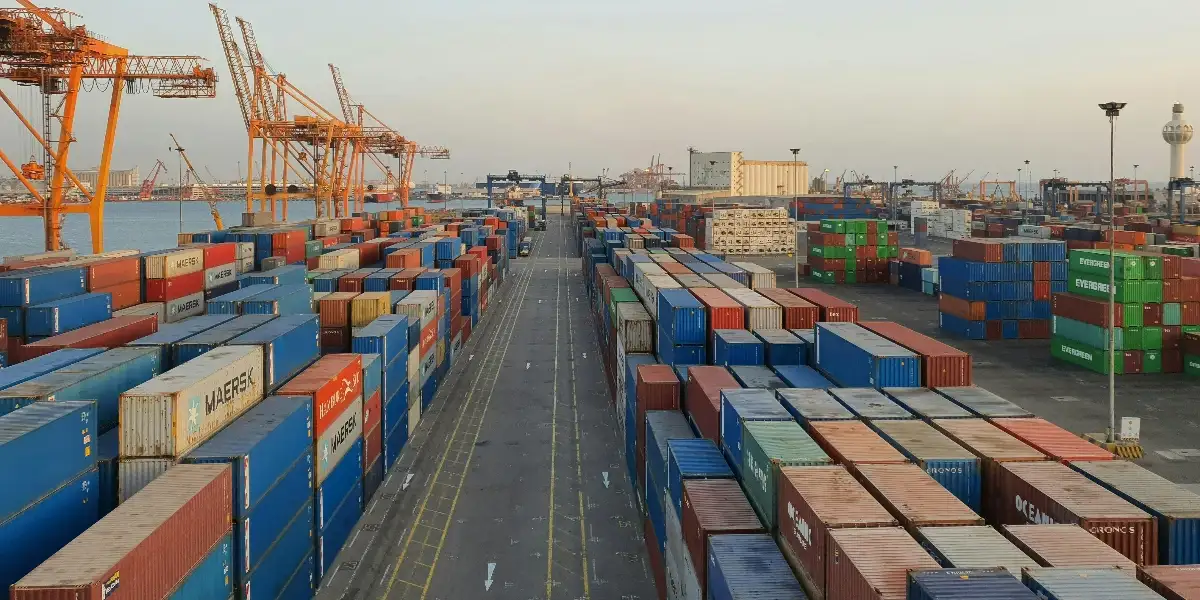
Get weekly port congestion insights from major global ports to see where congestion is intensifying, from highly congested ports to those showing long-tail delays.
Portcast's Q2 2026 Transit Time Report analyzes planned vs actual ocean transit times across major trade lanes to help logistics teams plan with measured data.
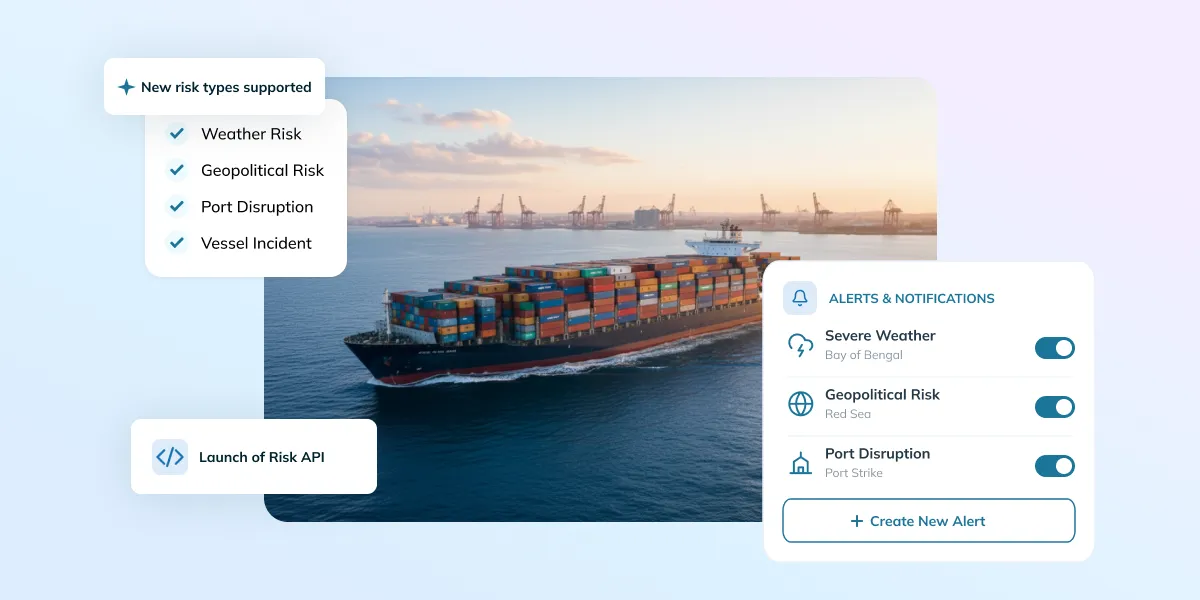
Learn how Portcast's expanded Risk Intelligence helps teams identify container-level disruptions earlier with new risk coverage, Container Risks API, and proactive alerts.


![[ロゴ]](https://cdn.prod.website-files.com/643006af9e6f61169be0dfb1/643006af9e6f611743e0dfee_Logo-Black-big.svg)