%201.svg)
If visibility alone could fix supply chains, delays would already be a thing of the past.
Yet every logistics team knows this is not how real operations work. People are still chasing updates across systems, recalculating ETAs, and explaining delays to customers only after the damage is already done. Ports get congested without warning. Vessels skip ports at the last minute. Containers show up where nobody expected them to be. And most systems still break the news only when it is too late to change the outcome.
This reality sat at the center of the conversation when Nidhi Gupta, CEO of Portcast, joined Malcolm Harris on FreightWaves' What The Truck?!? podcast.
What made the episode stand out was that it went past the usual tracking workflow conversations. It surfaced a reality many teams already feel: more data does not help logistics unless it leads to better foresight.
Teams are not failing because they lack information. They are overwhelmed by information that arrives too late, lives in too many places, and rarely connects to what happens next.
As Nidhi put it during the conversation,
"Most legacy tools have a ton of data, but they still let the human operator interpret everything. The data is not connected enough, not timely enough, and not automatically interpreted to drive action."
That gap between information and action is where most of today's disruptions grow. Seeing that something changed is one thing. Understanding why it changed and what to do next is where the real value begins.
Predictive visibility is not optional anymore.
Port congestion, typhoons, labor shortages, rerouting, skipped ports, and vessel rollovers are now part of everyday operations. The question is no longer if disruption will happen. It is whether teams can see it coming early enough to react. Predictive visibility shifts the focus from reacting to anticipating.
One moment in the episode captured this idea better than any abstract explanation.
A container that went the wrong way
Nidhi shared a real shipment story. A company shipped a container from Jakarta to Vancouver. Midway through the route, the vessel reached Tacoma. Then something unexpected happened. The carrier skipped Vancouver entirely and redirected the vessel back across the Pacific to Asia. The container was offloaded in Busan and sat there for 11 days before a new vessel was assigned.
The shipment covered twice the distance it should have. The transit time doubled. The business impact did not happen at the port. It happened because nobody saw the change early enough to react.
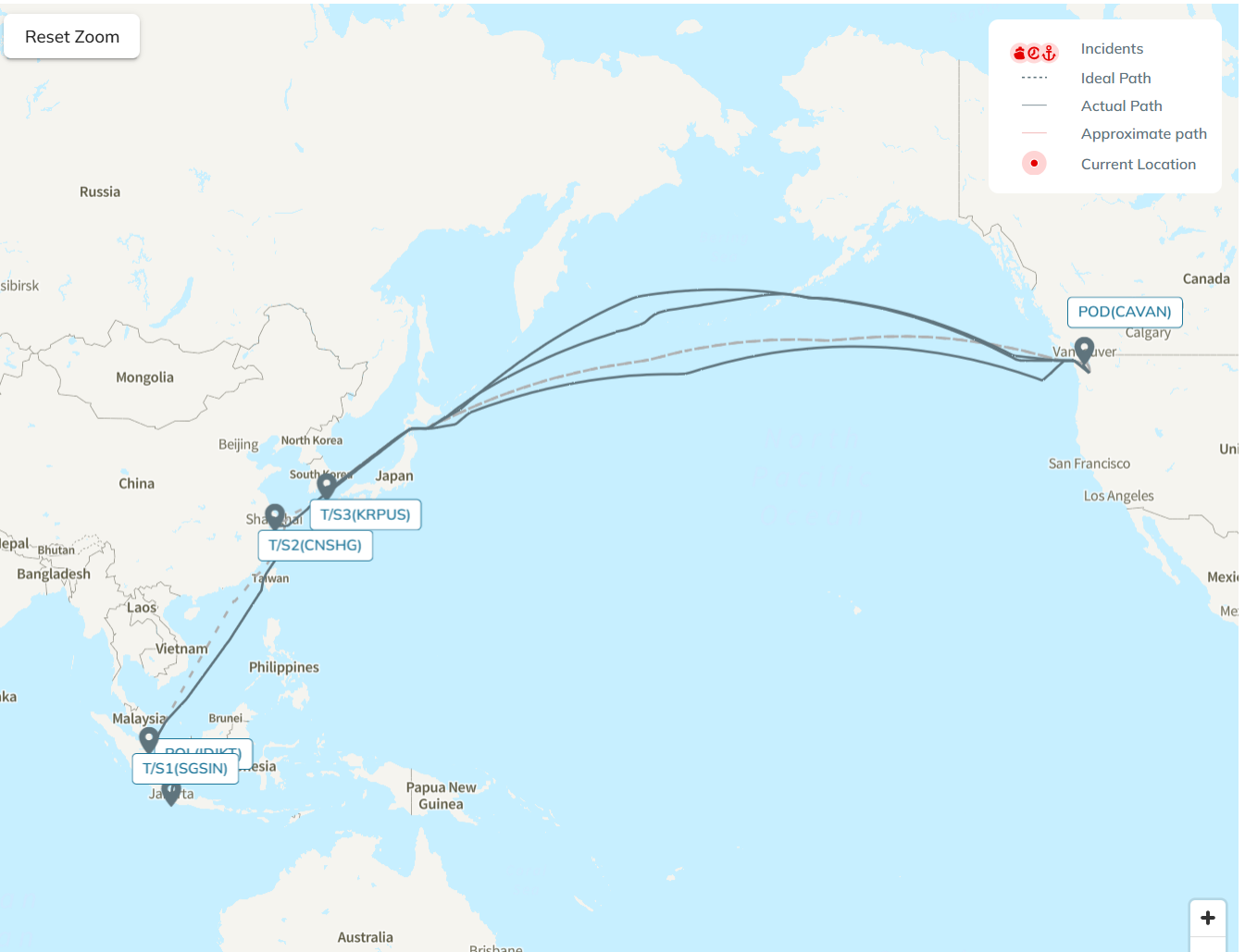
With earlier detection, that container could have been:
- Unloaded at Tacoma and trucked to Vancouver
- Rebooked faster onto another vessel out of Busan
- Rerouted before the delay compounded
Visibility tells you the container is now in the wrong country. Predictive visibility tells you when it is about to take the wrong turn.
Risk is no longer rare. It is the default.
A strong moment in the episode was when Nidhi described the nature of risk today.
"Risk is no longer occasional. It is structural."
That one line captures a lot of what supply chain teams feel daily. Planning is no longer about building around stable conditions. It is about operating in permanent uncertainty, including:
- Operational risks such as carrier-level changes like blank sailings, rollovers, or skipped ports
- External risks like extreme weather, political disruptions, and port congestion
- Financial risks from incorrect invoices, duplicate charges, and misaligned payments
When risk is constant, logistics teams need more than a reactive approach. Early detection becomes the only way to protect service levels and cost control.
The shift toward touchless supply chains has already started
Another insightful parts of the episode was Nidhi's discussion of "touchless supply chains".
When asked about the future of logistics, Nidhi did not describe something five or ten years away. She described something already happening. It is the industry's shift towards becoming more touchless in its operations.
AI is already reading logistics documents in multiple languages. Systems now surface billing issues before money ever leaves the business. And when vessel data, port congestion, and weather signals connect in the background, ETA accuracy gets better without teams having to chase it. Companies are moving toward more touchless operations, not to replace people, but to remove the manual work that slows them down.
When machines take over repetitive execution, teams finally have space for investigation, judgment, and decision-making. Operators are not replaced. They are relieved.
More importantly, some companies are no longer treating "touchless supply chains" as a vague ideal. They are measuring it. Tracking how much of their supply chain runs without human intervention. Not in theory, but in daily operations.
Watch the full episode
This conversation is packed with real-world examples and grounded insight.
Watch Nidhi's full discussion with Malcolm Harris on FreightWaves' What The Truck?!?



![[ロゴ]](https://cdn.prod.website-files.com/643006af9e6f61169be0dfb1/643006af9e6f611743e0dfee_Logo-Black-big.svg)
