%201.svg)
The conflict in the Middle East has led to the effective closure of the Strait of Hormuz, disrupting containerized shipping and supply chains across the Gulf and Asia-Europe routes. Carriers are suspending bookings and rerouting vessels, resulting in longer transit times, added costs, and growing risk exposure for shippers. We recommend that shippers monitor carrier advisories, and prepare for schedule and rate volatility.
This update focuses on what has happened so far, disruptions to containerized trade due to the Strait of Hormuz situation, and a live spreadsheet link with information on the container vessels impacted.
Effective Closure of the Strait of Hormuz: How Ocean Freight Has Been Impacted So Far
The Strait of Hormuz disruption has resulted in large-scale hesitation and course reversals across the container shipping industry, rather than a complete halt of all marine activity.
Vessels en route to or from the Persian Gulf began making U-turns within hours of the Hormuz Strait closure announcement. AIS data captured dozens of container vessels halting transits or reversing course, including vessels ranging from 700-TEU feeders to 6,700-TEU mid-size carriers.
At the same time, Houthi groups in Yemen have signalled a resumption of attacks on Red Sea shipping, effectively closing off the western approach to the Arabian Peninsula as well. This dual-chokepoint scenario, with the Strait of Hormuz closed to the east and the Red Sea volatile to the west, leaves Gulf-bound cargo with no fast-routing option.
Asia-Europe services that had recently returned to the Suez Canal routing, after more than two years of Cape of Good Hope detours, have reverted to the longer route around Africa. That shift alone adds approximately seven days to transit times on key loops, with cascading effects on vessel schedules, port calls, and equipment availability.
Carrier Advisories and Service Adjustments Following the Hormuz Strait Closure
As of April 20, major carriers have already implemented significant network changes in response to the Strait of Hormuz situation:
Hormuz Strait Impact: Transshipment Ports
As mainline vessels continue to avoid direct Gulf calls due to the Strait of Hormuz closure, Gulf-bound cargo is likely to be discharged at regional hubs such as Salalah, Sohar, Duqm, Khor Fakkan, and Colombo for feeder relay. This could create bottlenecks at alternative hubs absorbing diverted volumes.
Track the Vessels Impacted by the Strait of Hormuz Disruption in Real Time
To support the logistics and shipping community during this disruption, Portcast has compiled a live spreadsheet tracking vessels likely affected by the Strait of Hormuz closure. The list is updated continuously as the situation evolves.
Use it to assess exposure across your shipments and prioritize outreach to your carriers and forwarders.
Stay Ahead of Disruption with Predictive Visibility
As the Strait of Hormuz situation evolves, reactive tracking is not enough. Shippers and forwarders need early signals on vessel deviations, port congestion risk, and transit-time impacts before delays materialize.
Portcast provides real-time container tracking, predictive ETAs, and port congestion insights to help teams assess exposure and act faster during disruptions, such as the ongoing Hormuz shipping disruption.
How Portcast Customers Manage Such Disruption Risk
When a disruption of this scale unfolds, the challenge for logistics teams is knowing which shipments are affected, by how much, and what to do next. Broad advisories from carriers tell you what is changing at the network level. What matters operationally is understanding the impact at the shipment level.
Here's how Portcast's Command Center helps customers to isolate exposure and take action during events like the ongoing Strait of Hormuz disruption:
1. Isolate the geography: Start by scoping the impact zone. Filter active shipments by ports or countries of origin, destination, or transshipment hubs within the affected region. This immediately separates the shipments that need attention from those that do not.

2. Identify stranded or at-risk containers: Use exception-based filters to find containers that are already showing signs of disruption: idling at a transshipment hub, awaiting final vessel assignment, or sitting beyond normal dwell thresholds. These are the highest-priority shipments.

3. Quantify expected delays: For containers closest to the disruption zone, pull predictive ETA updates rather than relying on carrier-issued schedules, which tend to lag behind actual vessel movements. This gives the teams and their customers an earlier, more accurate picture of when cargo will actually arrive.
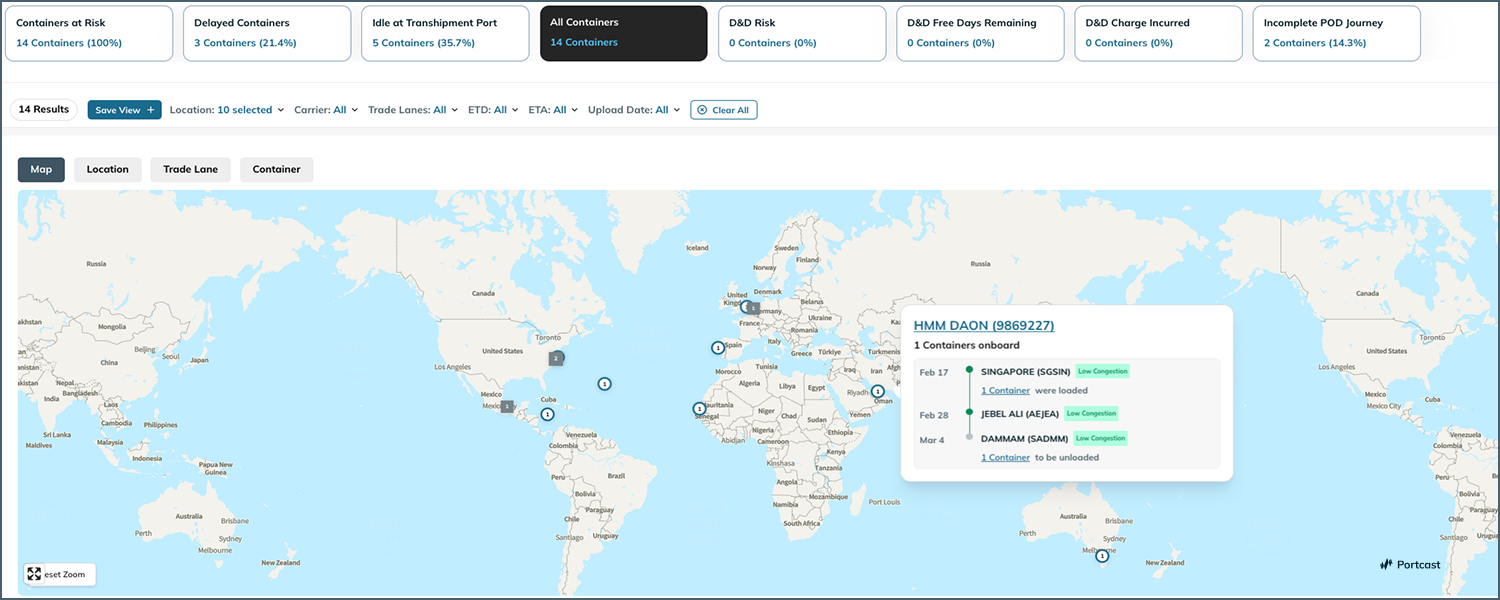
4. Drill down for resolution: For shipments that need active intervention, move to the container level. Granular, box-level data supports precise communication with drayage providers, warehouse teams, and end customers, reducing the back-and-forth that typically slows down exception management.

For blank sailing risk specifically, a sailing schedules calendar showing upcoming departures by route and carrier helps identify lanes where coverage is thinning before the blank sailing is officially announced, giving teams a window to rebook or adjust.

This kind of structured workflow applies beyond crisis events. Port congestion, blank sailings, carrier equipment shortages, and schedule reliability issues create similar operational and financial exposure on a regular basis. Having a system for isolating, quantifying, and actioning these risks is what separates teams that absorb disruption costs from those that avoid them.
Speak to our team to understand how Portcast can help you navigate such scenarios with greater confidence.
NOTE: This article was originally published on March 2, 2026 and has since been updated with the latest carrier advisories and vessel routing developments.
Our thoughts are with all those affected by the ongoing tensions in the region. We remain committed to providing the shipping and logistics community with timely, accurate information to help navigate these challenging times.