Real-Time Container Tracking Software, Verified and Predictive
Portcast's container tracking software stitches carrier milestones, AIS, schedules, port and terminal data, and market insights into one verified view of every shipment. Get AI-predicted ETAs, delay reasons, incident and risk alerts, and full journey visibility from booking to final delivery. Enter a booking, container, or bill of lading number and see where your containers actually are, not just what the carrier last reported, plus what is putting them at risk along the way.
Talk to our team.png)
Carrier Tracking Alone Does Not
Give You the Full Picture
Ocean visibility is hard because it depends on carriers, and carrier data has real limits. Updates arrive late, missing key milestones, and the events that matter often are not reported at all. Relying on carrier track-and-trace alone leaves gaps:
Lagging Updates
Milestones update slowly, so by the time an event appears, the situation has often already changed
Inconsistent Data
Data quality varies widely from one carrier to the next, and some provide only the latest event
Partial Picture
A single carrier feed leaves visibility gaps that only terminal data and live vessel AIS can fill
Unexplained Delays
Delays surface late and with no explanation, leaving your team to chase carriers for answers
Missing Market Context
Carriers show where a shipment is today, but not how external events like port congestion, strikes, typhoons, & other disruptions could impact it next.
Key Features of Portcast's Container Tracking Software
One Complete Container Journey, Stitched Together
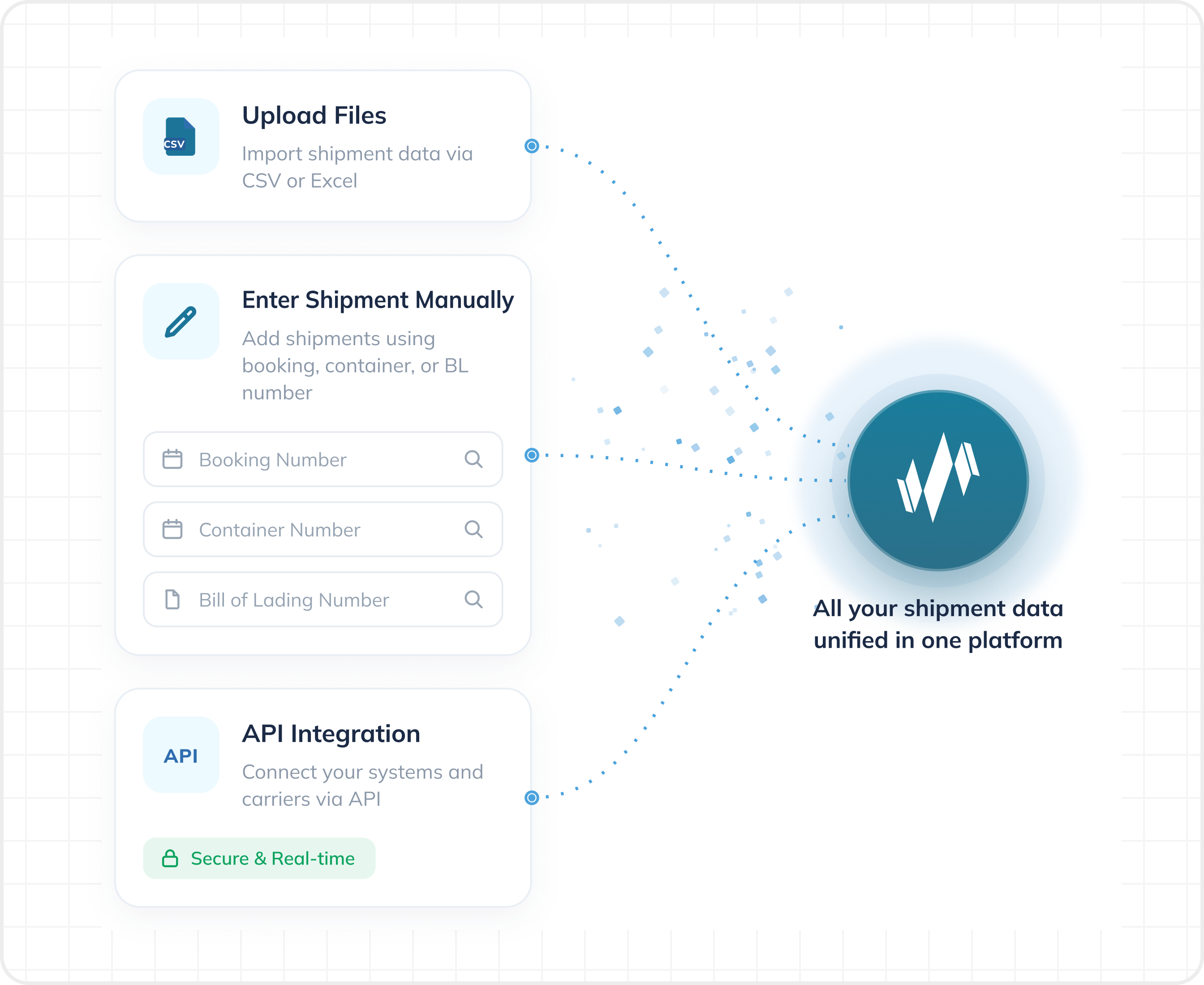
Enter a booking, container, or master bill of lading number to see the full journey in one place, including milestones, port calls, live vessel location, schedules, and transshipments. The timeline spans pre-loading to final delivery, with API-fed rail, road, warehouse, and order-level events stitched in where carrier data is unavailable.
Track by container, booking, or bill of lading to see all linked containers.
Standardized milestones across carriers: gate-in, loaded, departed, arrived, discharged, gate-out, and empty return.
Full transshipment visibility, so the journey holds even when containers change vessels.
Predict key milestones and events to benchmark carrier data and see every intermediate port.
Bring in your own events from non-supported carriers, rail, road, warehouse, and order-level data through the API, all stitched into the same journey.

Carrier Data, Verified Against Live Vessel Tracking
Portcast goes beyond carrier-reported data by combining carrier milestones with live vessel AIS tracking, geofenced port data, vessel behavior, and terminal events. When sources disagree, Portcast surfaces the differences and benchmarks source accuracy to create one trusted view of the shipment journey.
Combines carrier data with multiple sources for broader coverage and a more complete view.
Cross-checks carrier milestones against live AIS vessel data for greater accuracy and lower latency.
Surfaces AIS-observed departure and arrival times when they differ from carrier reporting.
Enriches journeys with port and terminal milestones, including Last Free Day, discharge, customs clearance, and pickup availability.
Automatically validates every data point before it reaches you.

AI-Predicted ETAs That Update With the Voyage
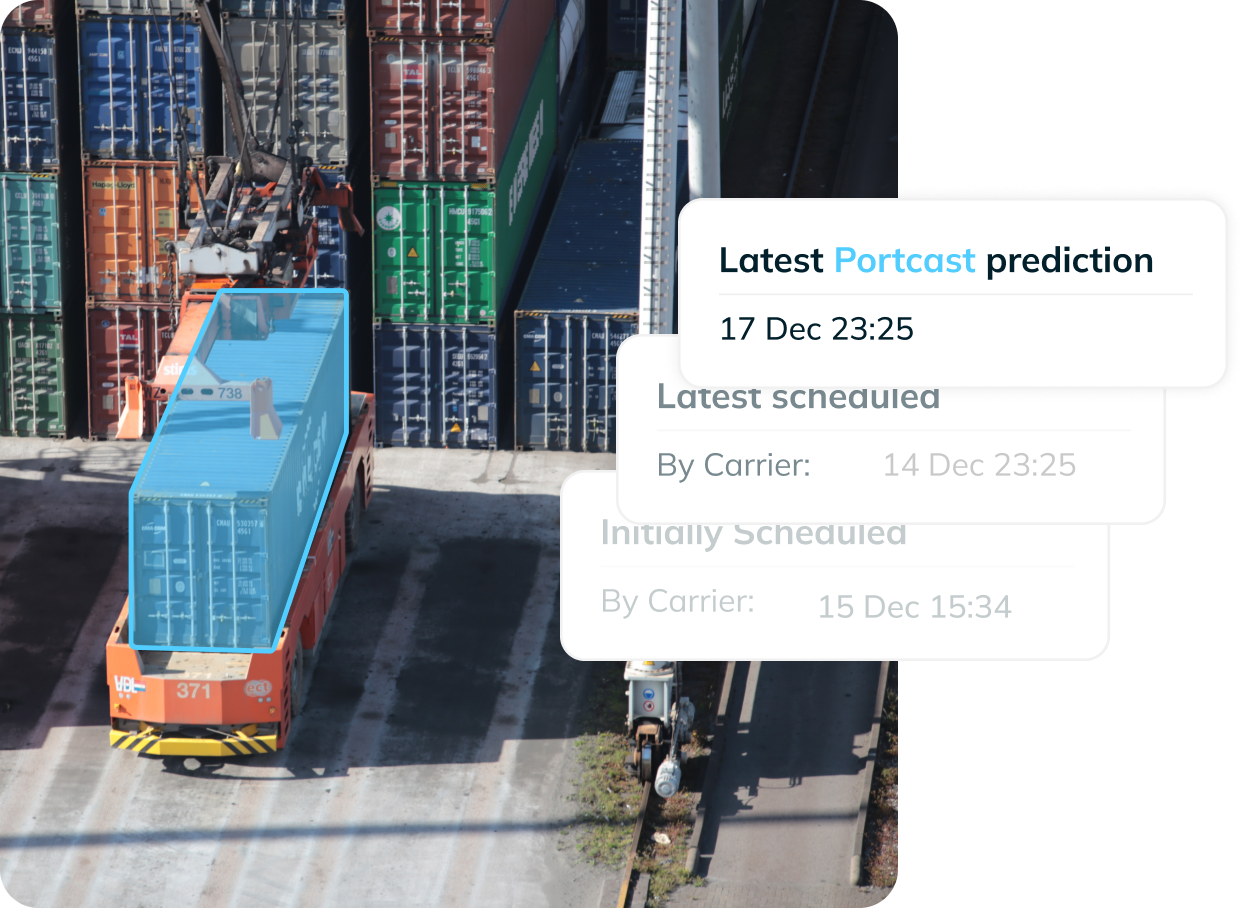
Portcast's predicted ETA uses proprietary, domain-specific machine learning across 70+ data sources. It continuously recalculates throughout the voyage based on actual departures, vessel routes and deviations, port congestion, weather, and disruptions, while showing delays as the gap between the carrier's ETA and Portcast's prediction.
Recalculates predicted ETAs as real-world conditions change, rather than relying on static carrier estimates.
Retains original and latest carrier ETAs alongside the Portcast prediction to benchmark carrier performance.
Surfaces delay reasons so every ETA change comes with context, not just a new date.
Validates predictions against multiple data sources and external events, including weather, geopolitical events, port congestion, strikes, and other disruptions.
Predictive ETA is a core part of what makes Portcast different. Explore how our predictive visibility works in depth.
Incident and Risk Alerts Before They Become Surprises
Portcast flags the events that can move your ETAs. It automatically detects operational incidents such as delayed departures, rollovers, and port rotation changes, while monitoring weather and geopolitical disruptions to identify exposed ports, vessels, and shipments and their precise impact windows.
Automatically detects delayed departures, rollovers, and port rotation changes.
Continuously monitors weather risks, including live cyclone tracking and changing forecasts.
Flags geopolitical and operational risks such as port strikes, closures, sanctions, and vessel incidents.
Delivered through the platform, Container Risks API, and push notifications to help prioritize mitigation and support D&D claims.
.png)
Don't take our word for it. Hear what our customers are saying.
From catching risks early, recovering freight costs, and making smarter planning decisions, here's how Portcast customers are winning back control of their supply chains.
"The most powerful functionality is predictive ETA, complemented by a complete end-to-end view of ocean events. It gives us the best accuracy of prediction and completeness of ocean view."
%201.svg)
“Portcast enabled us to offer customers a seamless tracking experience, strengthened relationships, and opened up substantial growth opportunities.”

“Portcast helps you to predict at an early stage how outside circumstances like weather, port congestion, and strikes may impact your and your customer's downstream processes.”

“Portcast has been a game-changer for us. By aligning ETAs with reality, we eliminated the noise around payments and gained complete clarity on our exposure.”
.png)
How Portcast Container Tracking Works
A global freight forwarder moved to Portcast from an existing tracking provider. They integrated historical shipment data to maintain full continuity, a dedicated project team ran the rollout to meet milestones, and weekly check-ins with hands-on training brought the operations team up to speed. The full switch went live in two weeks: one week of technical integration, one week of testing.
.png)
.png)
Container Tracking Software for Every Team That Depends on Ocean Freight
Freight Forwarders and 3PLs
Track high volumes across multiple carriers and clients from one place, without checking carrier websites one by one. Share live shipment tracking with customers through your own workflows, or deliver it via API, a fully white-labeled platform, or branded tracking pages for a seamless experience under your brand.
Shippers and BCOs
See every container in one place, get early warnings on delays, and give your teams and customers a single source of truth on where shipments actually are. Go beyond carrier-reported data and deliver a seamless tracking experience for both your operations team and customers.
Supply Chain & Procurement
Turn shipment data into actionable insights across your network. Analyze transit times, dwell, exceptions, and carrier performance, benchmark results against the market, and use these insights to improve planning, carrier selection, and procurement.
Turn Tracking Data Into Insight
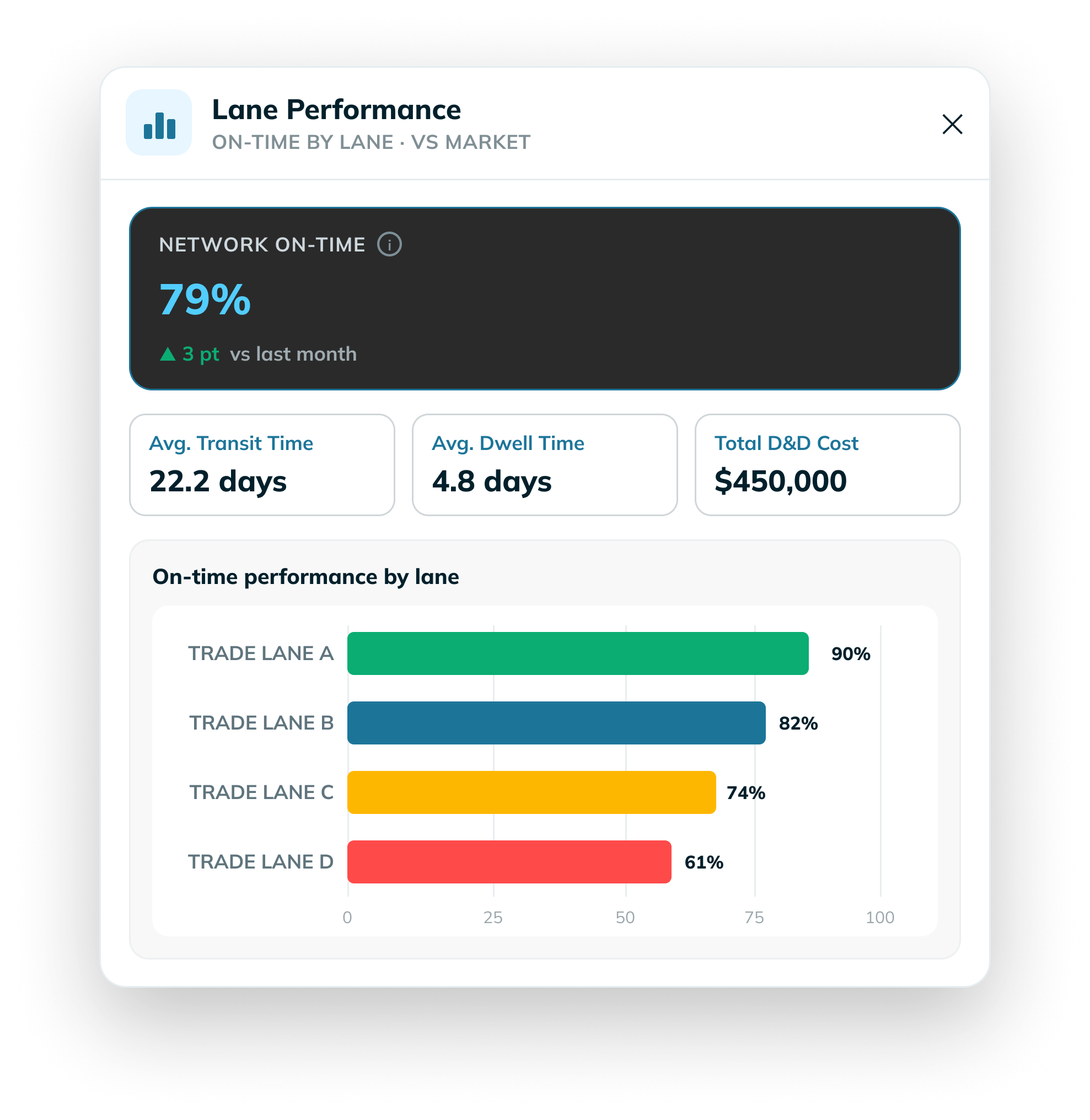
Container tracking is most useful when your whole team can see the patterns, not just individual shipments. Portcast lets you group and analyze visibility data by the dimensions that match how you operate, so reporting reflects your network rather than generic categories. Portcast also provides accurate benchmarks, helping you go beyond your own data to compare against the market, understand shipment performance, and measure carrier behavior.
Build views around how you operate, with custom regions, key accounts, carriers, lanes, and internal reference fields
Analyze shipment performance end to end, including transit times, dwell, exceptions, and D&D costs where available
Compare carrier performance by lane and port, and identify where service levels vary across your network
Benchmark against the market, combining your own shipment data with market performance to see where carriers are outperforming or falling behind

Container Tracking Software: Frequently Asked Questions
Any other question that isn’t mentioned? Don't hesitate to get in touch.
What is container tracking software?
How does Portcast's real-time container tracking work?
What types of billing errors does a freight audit help identify?
How many carriers does Portcast's container tracking platform support?
How does Portcast predict container ETAs?
Does Portcast include port terminal data?
Can I integrate container tracking with my TMS or ERP?
What is ocean container tracking?
How often is tracking data updated?
Learn More About Container Visibility


Get True Visibility Over
Every Container

 Get a Demo
