
%201.svg)
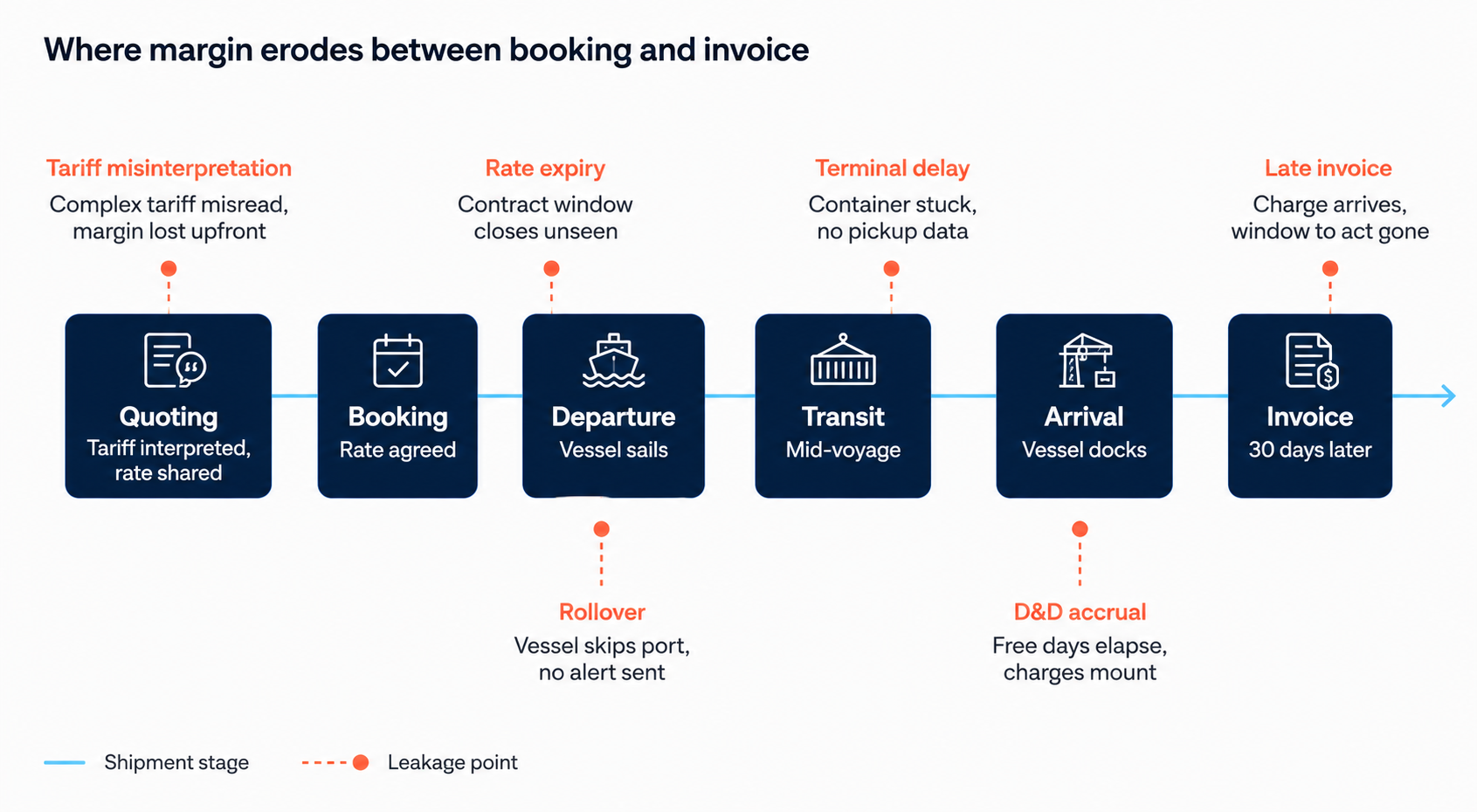
For freight forwarders, margin is rarely lost in a single moment. It erodes gradually across the lifecycle of a shipment. A delay that pushes a container closer to its last free day. A contract that quietly expires while the cargo is still in transit. A charge that arrives weeks later, long after the opportunity to question it has passed.
Individually, these are manageable. In aggregate, across hundreds or thousands of shipments, they reshape the economics of the business.
This guide is written for operations and finance teams who deal with this reality every day. The challenge is not recognizing that the margin is under pressure. The challenge is understanding exactly where it is being lost and why it remains so difficult to control.
The Margin Problem No One Is Tracking
The freight forwarding model is straightforward on paper. Buy at one rate, sell at another, and manage the spread. In practice, that spread is one of the least visible numbers in the organization.
Ask how profitable a shipment was, and the answer usually arrives after it has already closed. The P&L is reconstructed manually, often by an operator balancing multiple responsibilities, pulling together contract terms from scattered sources, and reconciling them against what appears in the system. Even then, the picture is rarely complete.
The inputs that determine profitability live in different places. Operational events sit in carrier systems and tracking tools. Contract terms exist in emails, spreadsheets, and shared folders. Charges accumulate over time, often without a clear connection to what triggered them.
Bringing these elements together requires effort, and that effort does not scale easily.
As organizations grow, the complexity increases. A forwarder managing multiple regions is dealing with hundreds of contracts, each with its own conditions, validity windows, and exceptions. A single shipment can interact with several of these. Understanding whether the shipment remains profitable requires connecting all of them, often after the fact.
What emerges is a pattern of small, repeated losses. A charge absorbed here. A missed recovery there. A contract that no longer applies by the time the vessel sails. None of these are large in isolation, but together they create sustained pressure on margins.
The problem is not invisible because it is hidden. It is invisible because it is distributed.

Where the Money Actually Goes
Margin erosion follows patterns. It tends to concentrate in the same places across most forwarding operations, shaped by familiar gaps between what is happening on the ground and what is captured in systems.
Carrier data that cannot be relied on
Carrier portals remain the primary source of truth for many teams, yet they rarely provide a complete or timely picture. Updates can lag behind reality, and the structure of the data varies across carriers.
Operators compensate by checking multiple sources, comparing vessel movements, and manually updating their internal systems. Even then, certainty is hard to achieve. A container may appear on schedule in one place and delayed in another system. A rollover may only become visible days after it has occurred.
This uncertainty has financial consequences. When the timing and status of a shipment are unclear, decisions are delayed. Pickup planning becomes reactive. Containers move closer to free-day limits without intervention. When charges arise, the supporting evidence needed to challenge them is often incomplete.
Over time, this weakens both cost control and recovery.
Exceptions discovered too late
In many operations, exceptions surface only when someone looks for them. A client calls. A shipment is checked. A delay that happened earlier comes to light.
By that point, the options are limited. Routing changes are no longer viable. Free days have already been consumed. What could have been managed becomes something that must be absorbed or passed on.
At scale, this becomes harder to manage. Teams are responsible for large volumes of shipments, and without clear prioritization, attention is spread evenly. The shipments that carry the highest financial risk are not always the ones that receive it.
The cost is not just operational inefficiency. It is the gradual accumulation of avoidable charges.
The gap inside the terminal
One of the more expensive blind spots sits between vessel arrival and container availability.
Carriers report when a vessel docks, but what happens within the terminal is less visible. Discharge timelines, congestion, and holds can delay availability well beyond the arrival time.
Without this information, planning becomes guesswork. Trucks are dispatched based on incomplete signals. Some wait unnecessarily. Others arrive too late.
The financial impact is immediate. D&D charges rise. Haulage costs increase. These are not exceptional cases. They are routine outcomes of operating without terminal-level visibility.
Contracts that expire mid-voyage
Rate validity is another area where margin quietly erodes. A shipment may be quoted and booked under a valid contract, only for delays to push it beyond that contract’s window.
By the time the shipment moves, the underlying rate has changed. The margin assumed at booking no longer exists.
This often surfaces only during invoicing, when there is little room to adjust. Across multiple shipments, this becomes a recurring source of loss.
Detention and demurrage as a cumulative effect
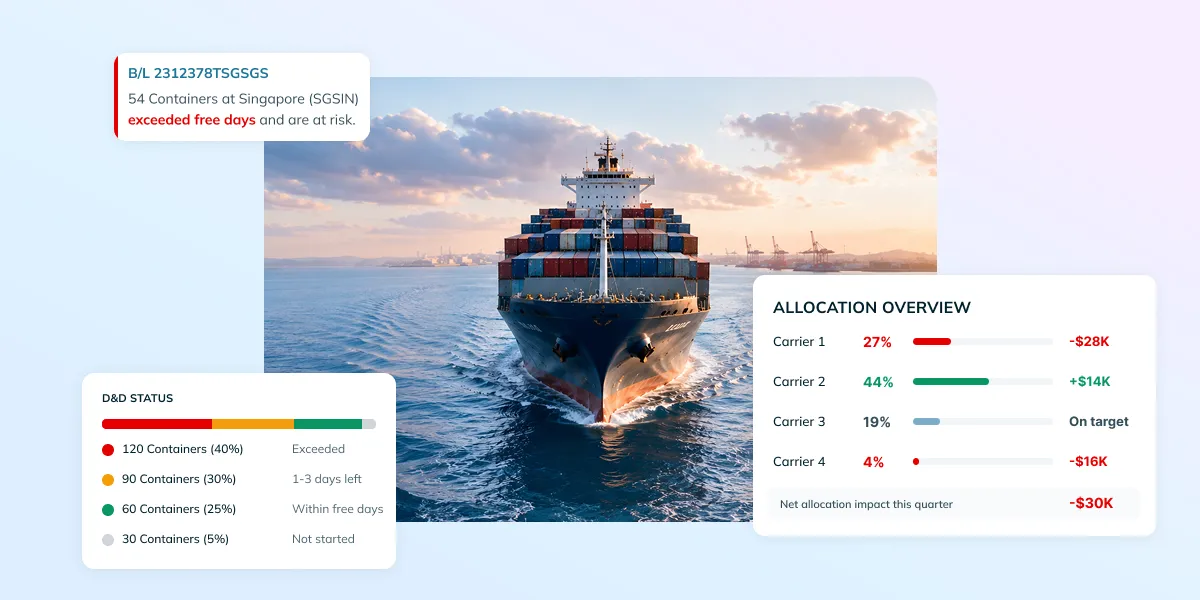
D&D reflects the combined impact of multiple gaps. Delays are identified late. Free days are not actively monitored. Pickup decisions are made without full context.
Charges build gradually and become visible only when invoiced. At that stage, the ability to challenge them depends on having a clear record of events. Without that, disputes are difficult to sustain.
For forwarders, the situation is further complicated by their position between carriers and clients. Determining responsibility requires evidence, and evidence depends on data that is often fragmented.
The human cost of manual data movement
Alongside direct financial leakage is a less visible cost. Operators spend a significant portion of their time moving information between systems, verifying statuses, and responding to routine queries.
This affects both cost and capacity. As shipment volumes grow, teams expand to keep up. Efficiency gains are limited because the underlying work remains manual.
Visibility has improved over time. Many forwarders now have access to tracking tools and milestone updates. What remains unresolved is how that visibility connects to financial decisions.
Knowing that a shipment is delayed is useful. Understanding what that delay means for margin, and what action it requires, is where the real value lies.
The Financial Workflow That Requires More Than Basic Visibility
Visibility has improved over time. Many forwarders now have access to tracking tools and milestone updates. What remains unresolved is how that visibility connects to financial decisions.
Knowing that a shipment is delayed is useful. But it is only the first part of a question that needs a much more complete answer:
What does this delay mean for this shipment's profitability, and what do I need to do about it right now?
The P&L that builds itself, or doesn't
In most organizations, the financial view of a shipment is constructed after completion. Operators gather rate information, apply charges, and build the P&L manually.
This approach creates a delay between events and understanding their impact. By the time the margin is clear, the opportunity to influence it has passed.
When operational data and contract data are brought together in real time, this changes. The financial position of a shipment can be updated continuously. Events that affect cost can be identified as they occur, along with their implications.
This allows teams to act earlier, when there is still flexibility.
Managing contracts at scale
Contracts are central to profitability, yet managing them at scale is challenging. They are often stored in decentralized formats, with limited standardization.
Applying the correct contract to a shipment requires context. Keeping track of updates, expiries, and exceptions adds another layer of complexity.
Without a structured approach, contract data remains disconnected from day-to-day operations. Financial decisions are made without full visibility into the terms that govern them.
The allocation decision nobody is making optimally
Every shipment involves a decision about which contract or carrier to use. These decisions are influenced by timing, availability, and existing commitments.
In practice, they are made with partial information. Changes in schedules or conditions may alter what the optimal choice would have been, but by then the decision is already in motion.
The ability to revisit and adjust these decisions based on updated information directly impacts margins. In most operations, this remains difficult to execute consistently.
What Good Looks Like: Evaluating a Solution
The market offers a wide range of visibility and intelligence tools. The challenge is identifying which ones meaningfully improve financial outcomes.
Data that is both accurate and usable
Access to multiple data sources is now common. The differentiator lies in how that data is applied.
When visibility exists as a separate layer, it provides information but leaves interpretation and action to the operator. The connection to financial impact remains indirect.
Bringing operational data together with contract terms and shipment context allows events to be understood in terms of cost. This is where visibility begins to influence outcomes.
Exception management that prioritizes, not just alerts
Alerts are useful when they direct attention effectively. In high-volume environments, prioritization becomes essential.
Understanding which shipments carry the highest financial risk allows teams to allocate effort where it matters most. Over time, this creates a more consistent approach to managing exceptions.
The same data also supports broader decisions. Patterns in delays, performance, and cost exposure inform how carriers and routes are evaluated.
Linking audit to operations
Freight audit sits at the point where operational reality meets financial reconciliation.
Reviewing invoices against contracts is necessary, but it does not capture the full picture. Charges that arise from operational events require context to assess accurately.
When audit processes are connected to shipment data, discrepancies become easier to identify and address.
Operating at scale
Forwarders operate across multiple dimensions: customers, carriers, and geographies. Solutions need to reflect this complexity without adding to it.
A consolidated view of shipments, combined with the ability to prioritize and analyze across the portfolio, supports both operational and financial oversight.
Adoption and integration
The effectiveness of any solution depends on how easily it fits into existing workflows. A solution that requires months of integration work before delivering any value will lose internal support before it is ever fully deployed.
Approaches that build on current systems and processes tend to gain traction more quickly. Integration that delivers value early helps maintain momentum and supports broader adoption over time.
Getting Started Without Disruption
The operational and financial case for better tooling in freight forwarding is clear. How long will this take? What will it disrupt? How do we get the teams that are already stretched thin to change how they work?
These are legitimate concerns, and any honest conversation about technology adoption in freight forwarding has to address them directly.
Augment first, overhaul later
The most effective implementations improve what teams already do instead of replacing it. If operators are building shipment P&Ls in spreadsheets, the first step is to improve the data feeding into those workflows, not rebuild them entirely.
Better data, delivered automatically, reduces effort and improves accuracy without forcing immediate change. This lowers resistance, shortens adoption cycles, and builds confidence. A deeper transformation can follow once the value is clear.
Faster time-to-value with API-first integration
For forwarders with existing systems, API-based integration is often the most practical path. Capabilities such as predictive ETAs, terminal milestones, and container tracking can be embedded directly into current interfaces.
Operators continue working in familiar systems. Clients continue seeing the same interface. The intelligence improves in the background.
This approach delivers value quickly, often in weeks rather than months, while avoiding large-scale disruption.
White-label tracking links are a simple example. They provide clients with accurate, real-time updates without adding to operator workload, reducing status queries and freeing up time for higher-value work.
Real Example: What the Numbers Look Like
Quantifying financial impact in freight forwarding is not straightforward. Data is fragmented, baselines are unclear, and the link between operational changes and financial outcomes is rarely tracked end to end.
What is clear from real deployments is that the impact is meaningful across multiple areas. For example, one of Portcast’s customers, a Europe-based digital freight forwarder managing over 60,000 containers annually, saw:
- ~85% reduction in manual tracking and data consolidation
- ~40% faster exception resolution
- 94% ETA accuracy four days before arrival
- ~25% improvement in overall operational efficiency
- ~15% reduction in D&D charges
- Significant improvement in cash flow, up to 30% savings on freight audit
These results reflect one deployment, but the pattern is consistent. When the data foundation improves, the gains are not incremental. They show up clearly across cost, efficiency, and service.
Final Note
Margin pressure in freight forwarding is shaped by complexity. More carriers, more contracts, and higher expectations around service and transparency.
Addressing it requires connecting what happens operationally with what is understood financially, while there is still time to act.
The organizations that succeed in this are those that reduce the gap between these two worlds and make that connection part of how they operate every day.
About Portcast
Portcast works with some of the world's largest freight forwarders, including global top-20 operators managing multi-region flows across hundreds of trade lanes and thousands of containers each month.
Portcast's predictive visibility platform is built on real-time ingestion of port-, lane-, and vessel-level risk signals, feeding into a prediction model that updates continuously as voyage conditions change. The command center surfaces exceptions based on your configured thresholds and integrates with your existing TMS, ERP, and planning tools, ensuring alerts and actions occur within the workflows your team already uses.
For forwarders with their own client-facing platforms, Portcast supports full white-label deployment: tracking links, ETA data, and shipment milestones, all delivered under your brand, with no client-side development required.
For teams that prefer to work within Portcast's own interface, the command center provides a unified view across all shipments, carriers, and customers, with exception prioritization, delay explanations, and D&D risk surfaced in one place.
If you'd like to explore how the solution works on your real shipment data, schedule a call with our expert team.


![[ロゴ]](https://cdn.prod.website-files.com/643006af9e6f61169be0dfb1/643006af9e6f611743e0dfee_Logo-Black-big.svg)
