%201.svg)
Every time a container is delayed, shippers and freight forwarders can lose up to $1,500 in direct costs alone, not including downstream effects on customer relationships or supply chain performance. Yet most teams struggle to spot which shipments will cause problems before they impact profits, customer commitments, or cash flow.
Risks in global supply chains take many forms. A vessel might miss a connection at a transshipment point. Congestion at port can delay berthing for days. Containers may be rolled to the next sailing or left sitting at the terminal longer than expected. Sometimes, invoices arrive with charges that are hard to match to real shipment events.
Each of these might appear to be a simple operational issue. In reality, they are freight risks that can directly impact costs, service quality, and customer trust.
This is where freight risk management becomes essential.
The freight risks that quietly disrupt shipments and margins
Freight risk management connects operations and finance. It is a key part of risk management in logistics and supply chain because disruptions and costs are closely linked.
On the operational side, common shipping risks include:
- Congestion at the port that increases waiting time and delays berthing
- Vessel schedule changes and blank sailings that shift ETAs by multiple days
- Transshipment risk that results in missed connections
- Container rollover that pushes cargo to the next vessel
- Terminal dwell spikes that eat into free time
- Customs unpredictability in certain corridors
All of these issues create container risk. While the delay might be visible, the downstream impact is often not clear right away.
On the financial side, these disruptions trigger measurable cost exposure:
- Demurrage and detention charges when containers exceed free time
- Contract rate leakage when spot rates or surcharges are applied incorrectly
- Invoice discrepancies that do not align with actual shipment milestones
- Accessorial charges that are difficult to validate without granular shipment data
For a Beneficial Cargo Owner (BCO), a late shipment can lead to production delays, stockouts, or customer penalties. For a freight forwarder, it can mean more escalations, tough talks with carriers, and smaller profit margins.
Why most companies detect freight risks too late
BCOs and freight forwarders handle hundreds or thousands of containers at once, moving them through many carriers, ports, and trade lanes. The real challenge is not just seeing where containers are, but focusing on the 8% of containers that cause 80% of the risk before it's too late.
Most failures in freight risk management stem from a few typical process gaps.
Too many updates, no predictive prioritization
Operational teams get a steady stream of updates from carrier websites, emails, EDI feeds, and tracking systems. ETAs shift, vessel schedules change, and transshipment details update often.
But these updates only show what has already changed. They rarely indicate which shipments are most likely to miss delivery windows, get rolled over, or incur demurrage risk.
Without shipment-level risk scoring, every update appears equally important. Teams end up monitoring everything while struggling to prioritize the few containers that truly require intervention.
The end result is that demurrage risk builds quietly while attention is spread thin.
Alert fatigue masks high-impact disruptions
When every delay triggers a notification, alerts quickly lose meaning.
Minor ETA shifts and high-impact disruptions appear in the same stream of updates. Over time, teams become desensitized to alerts. What should drive action becomes background noise.
In this environment, serious issues like transshipment risk or growing port congestion might not get noticed soon enough. By the time the problem becomes clear, the container could already have been rolled to the next vessel or be approaching the end of free time.
Manual consolidation slows risk detection
In many companies, shipment data still flows into spreadsheets for consolidating and reporting. Operations teams pull updates from different systems to get a full picture, but this manual work delays the detection of emerging risks.
Patterns such as repeated container rollover on critical trade lanes or increasing dwell time at a congested terminal are often identified only after manual review. By then, the window to re-plan pickups, inform customers, or prevent demurrage costs may already be closing.
Missed handoffs between operations, finance, and customer teams
Operations teams are usually the first to spot delays. They notice when an ETA slips, a container misses a connection, or a container sits at the terminal too long. But this information often doesn't reach other teams quickly enough.
Finance teams feel the effects later, when they have to investigate demurrage and detention charges invoices. Without connected freight risk management, signals from operations are not linked to real-time costs.
Customer-facing teams are left explaining delays without clear visibility into their root causes.
This is where freight risk management often breaks down. One system shows the risk, another shows the cost, and no single team sees the complete picture.
What effective freight risk management looks like
The best companies at managing freight risk aren't the ones with the most alerts. They focus on spotting container risks early, prioritizing the right shipments, and acting before disruptions turn into extra costs.
Effective freight risk management can be achieved with four capabilities:
1. Predictive visibility into shipment delays
Teams need to spot risks before they show up in the final ETA. Predictive ETAs that factor in carrier performance, port congestion, and past trends help teams see which shipments are likely to be delayed, not just the ones that are already late.
2. Understanding the cause of delays
It's important to know that a shipment is delayed, but teams need to know why the delay occurred.
Whether the delay is due to port congestion, missed connections, or vessel schedule changes, the cause of the delay lets teams know what actions to take.
3. Shipment-level risk scoring
Not all delays matter the same. For example, imagine a container is held up for 2 days at the origin. In many cases, there might be flexibility to load it onto a later vessel or adjust the pickup without major cost or operational implications. But if that same two-day delay occurs before arrival at a congested transshipment port with few alternative sailings, it can trigger a missed connection, push the container onto the next available vessel (a rollover), and potentially create downstream consequences at the final destination.
The financial gap between these two scenarios can easily reach thousands of dollars, even though the initial delay duration is the same. By prioritizing risks, teams can focus attention on the delays that have a real impact, prevent avoidable charges, and protect margins.
4. Linkage of operational risks to financial exposure
Freight risk management should link operational signals to cost risks. If a container is likely to exceed free time based on new arrival and terminal data, finance teams shouldn't wait for the invoice to see its impact. Early warnings help manage demurrage and detention proactively, rather than just react after invoices arrive.
How early risk signals improve day-to-day decisions
In Portcast's Command Center, shipments most likely to cause issues are surfaced automatically, and we've noticed our customers reacting up to 50% faster to emerging delays and reducing time spent on low-value tracking by up to 85%.
Rather than just providing predictive ETAs or port congestion trends as data points, the system translates this complex information into actionable, early risk alerts, leading to fewer missed delivery windows, reduced demurrage costs, and faster exception handling.
At a glance, teams can see:
- Which shipments carry the highest container risk
- The primary delay driver, such as congestion or a missed connection
- Which containers require immediate intervention
Here's an example:
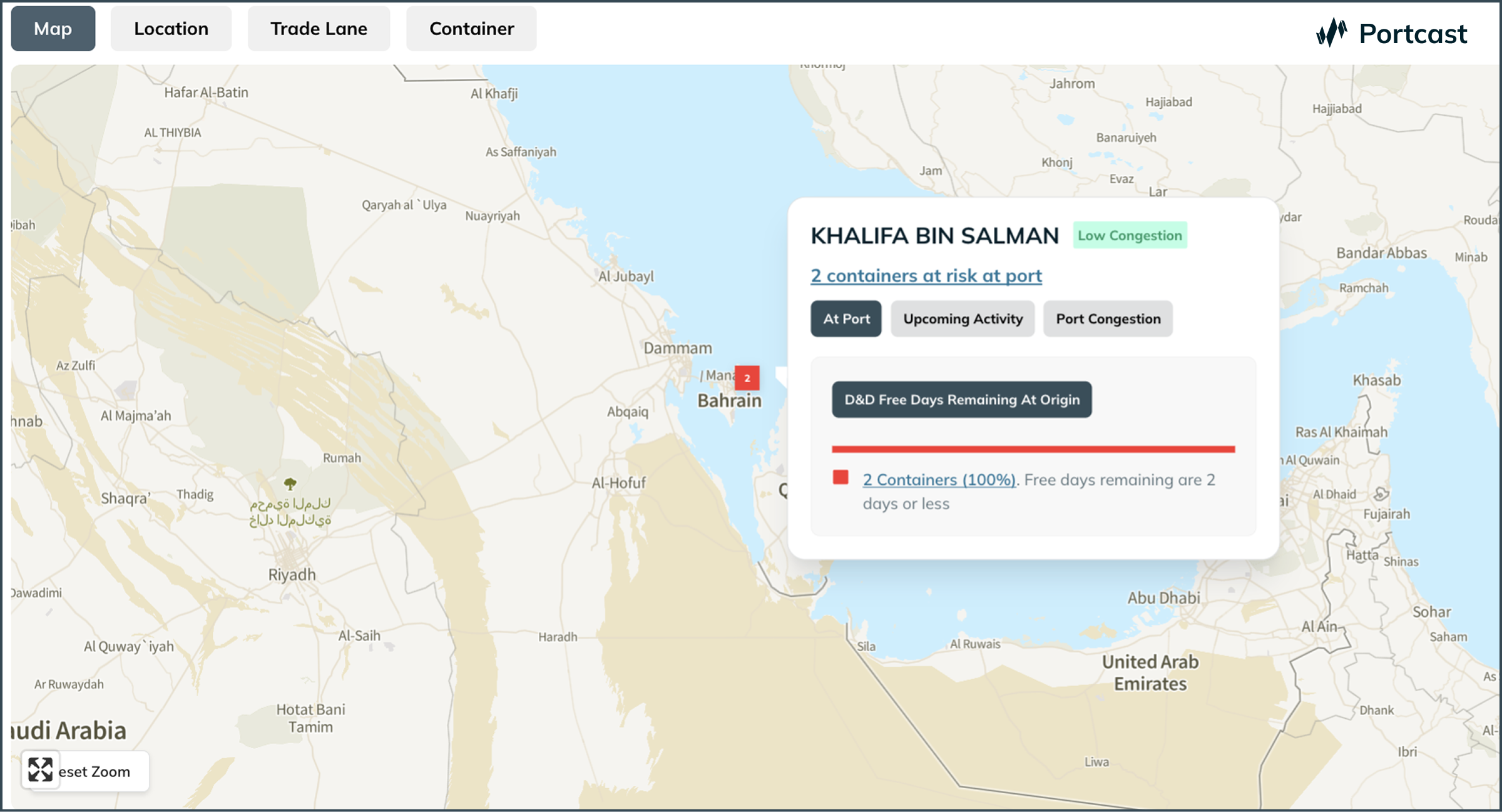
In the view above, for one of its customers, Portcast's Command Center flags two containers, sitting at the Khalifa Bin Salman port, that are quickly approaching free time limits. Instead of monitoring hundreds of shipments equally, the logistics team can immediately focus on such specific containers that pose higher operational and cost risks.
This example also highlights an important aspect of freight risk management. Container risk can surface even when overall port congestion is low. A port may be operating normally, but individual containers can still approach free time limits due to dwell patterns, documentation delays, or pickup coordination issues.
By surfacing these risks early, teams do not have to discover detention or demurrage exposure weeks later through invoices. Instead, they can identify containers nearing free time thresholds while still at the port and prioritize pickup planning before charges begin to accrue.
Rather than asking teams to interpret raw milestone data across multiple systems, the Command Center translates operational signals into clear risk indicators. Containers approaching free time limits or dwell thresholds are highlighted directly on the map, making it easier to focus on shipments that require immediate action.
This approach makes it easy for:
- Operations teams to focus on the right shipments and adjust pickup plans before demurrage becomes an inevitable risk.
- Finance teams to receive early warnings of potential costs, enabling them to manage demurrage and detention proactively before invoices arrive, or even avoid their issuing altogether.
- Customer-facing teams to communicate confidently, because they know both the root cause and likely impact of delays, instead of waiting for problems to escalate.
Bringing it all together
Freight risk management isn't about eliminating disruptions altogether. In global shipping, some disruptions are inevitable.
The key is empowering teams to spot these risks and respond quickly before they affect your margins and service levels
Companies that spot risks early, set clear priorities, and connect operations with finance can cut avoidable costs and service failures.
- Proactive companies notify customers about potential delays in advance, adjust plans before costs escalate, and prevent customer penalties.
- Reactive companies apologize to customers after disruptions, pay unexpected demurrage charges, and scramble to explain service failures only after they occur. Those who rely on manual tracking and delayed alerts stay stuck in a reactive cycle.
If your team faces these challenges, Portcast can show you how proactive freight risk management works and how other shippers and freight forwarders handle exceptions more effectively.