
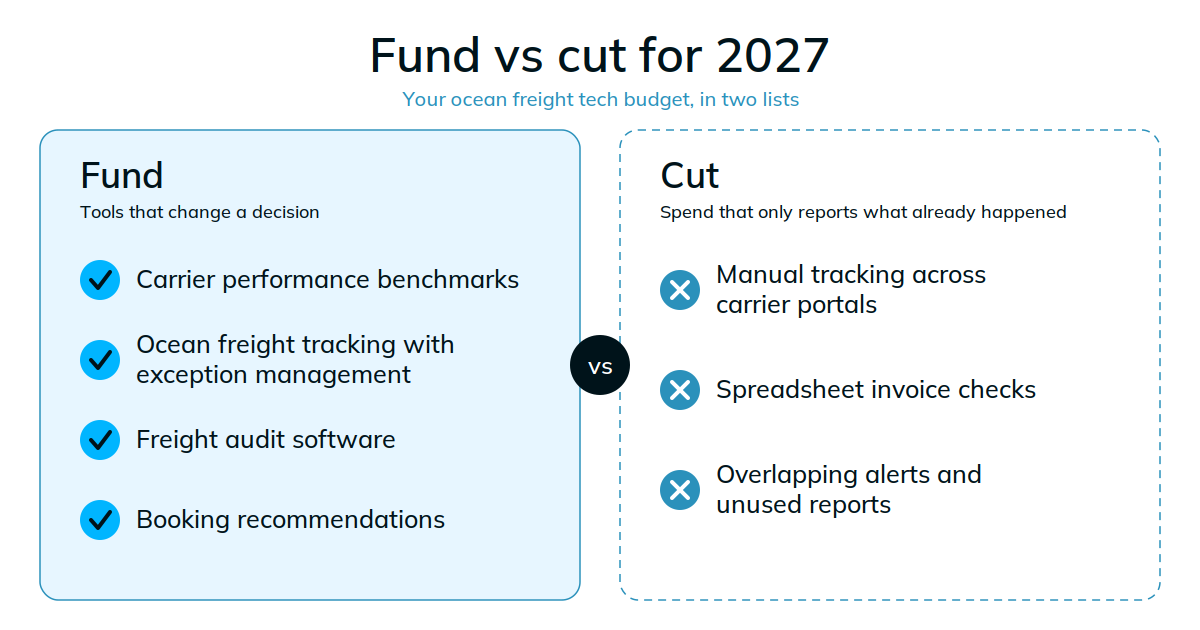
Fund the tools that change a decision before a shipment sails or an invoice is paid, and cut the ones that only report what already happened. For freight forwarders and BCOs, this means prioritising four areas in 2027:
- Carrier performance benchmarks to support smarter tender decisions.
- Ocean freight tracking with proactive exception management.
- Freight audit software to identify discrepancies and prevent unnecessary costs.
- Booking recommendations to make better-informed booking decisions.
The first areas to cut back on are manual tracking, spreadsheet-based invoice checks and overlapping alert tools.
This guide gives a three-question test for every budget line. For each area, it covers the pain, the Portcast solution and a customer number. It also shows where freight forwarders and BCOs should invest first, and which spend to cut.
A Three-Question Test for Every Budget Line
Ask three questions about every tool and process on your 2027 list before you assign a number to it.
- Does it change a decision? A tool earns its place when it moves a booking, a pickup or a dispute. A dashboard that shows last month's performance after the fact does not.
- Can you measure the result in money or hours? Pick one number per line, such as D&D charges avoided, disputed invoice value or planner hours saved per booking.
- Does it replace manual work? If your team still checks the same carrier portals and spreadsheets after rollout, the new tool adds cost without removing any.
What to Fund in 2027
Each area below passes the three-question test. For each one, you get the pain, the Portcast solution and a customer number to size the line.
Carrier Performance Benchmarks for Tenders and Contracts
The challenge: Carrier reliability looks good on paper, but reality often tells a different story. When the tender season arrives, every carrier claims to be reliable. Procurement gets trade-lane averages, sales presentations and promises from carrier representatives. But once the booking is made, the sailing schedule can change. This creates a disconnect between procurement and operations: procurement negotiates based on one set of data, while operations deals with another reality. The consequences are real: unexpected delays, expedited shipments, rebookings and additional costs.
The solution: Marina gives procurement the data to make smarter carrier selection and tender decisions. Marina, Portcast's Market Reliability Agent, benchmarks carrier performance at the bookable service level across your trade lanes, using the schedules published approximately three weeks before departure. This includes both direct and transshipment routes. You get visibility into on-time performance by comparing announced schedules with actual transit times, with reliability broken down by individual transshipment ports. You can also compare your contracted carriers against the overall lane average, giving procurement an objective view of carrier performance beyond commercial promises and historical trade-lane averages. With Marina, carrier selection becomes a data-driven decision.
Booking Decisions and Allocation Planning
The challenge: Booking decisions are made with limited information, often leading to unnecessary costs and operational issues. Booking happens fast. An operator checks one or two carrier websites, selects the sailing that appears available and moves on. But the cheapest option may run through a congested hub or have a poor reliability record. At the same time, carrier allocations are agreed for each contract period, yet booking teams rarely have visibility into actual utilisation against those commitments. As a result, contracted space goes unused or gets overused, creating missed opportunities and additional costs. And when a booking rolls, the window to react and amend it is often very short. Without visibility into carrier reliability, port conditions, available alternatives and contract utilisation, booking decisions stay reactive.
The solution: Reef helps your team make smarter booking decisions, balancing cost, reliability and service priorities. Reef, Portcast's Routing Agent, searches available sailings across both direct and transshipment routes and evaluates each option against your priorities. It scores sailings based on carrier reliability, earliest arrival, disruption avoidance, price, preferred carriers and contracted allocation, taking into account the priorities you define for each booking. Your operators receive a ranked shortlist of the best available options, with clear explanations behind each recommendation. Your team stays in control and makes the final booking decision, but with better information, more visibility and less manual research.
Ocean Freight Tracking and Exception Management
The challenge: Your team spends more time chasing shipment updates than managing exceptions. Your team opens carrier portals one by one, manually copies statuses into spreadsheets, and still ends up hearing about delays from customers first. Carrier ETAs can change significantly close to arrival, when pickups, hauliers and warehouse slots have already been booked. The consequences go beyond operational inconvenience. When shipments are delayed and free time expires, demurrage and detention charges start accumulating. Recovering these costs afterward is often slow and difficult. Without reliable exception management, teams constantly react.
The solution: Portcast turns ocean freight visibility into actionable decisions. Portcast's container tracking software provides one verified journey for each container, checked against live vessel AIS data across 220+ carriers. Portcast integrates terminal data and terminal ETAs, giving teams visibility of both vessel arrivals and expected terminal operations. Portcast identifies delay reasons and milestones behind schedule changes, helping flag at-risk shipments before they become operational problems.
Darya, Portcast's Daily Agent, brings this intelligence together. It reviews and ranks shipments overnight, highlighting ETA changes, terminal delays, emerging risks and potential demurrage and detention exposure. Each operator receives a daily brief showing what changed, why a shipment is at risk and what requires attention or a decision today. This is ocean freight visibility your team can act on.
The number: A global food manufacturer using Darya across 30,000+ containers a year and 50 operators avoids about $300k in D&D charges each year, has about 1,500 containers flagged in time and cuts morning review time from 45 to 10 minutes per operator (Portcast estimates). A South American forwarder moving 20,000+ containers a year cut manual tracking effort by about 90% with automated, API-based tracking.
Freight Audit Software for Invoice Errors and Demurrage Charges
The challenge: Your team spends hours checking invoices, but still ends up paying charges it shouldn't. Ocean freight invoices arrive in different formats, often with vague or inconsistent charge descriptions. Your team has to check them line by line against carrier contracts, tariffs and agreed terms. Yet discrepancies still slip through: accessorial fees outside agreed terms, detention charges calculated against the wrong free time, and surcharges that were never part of the contract. Manual checks are time-consuming, difficult to scale and leave too much room for error. Ultimately, whatever goes unnoticed gets paid.
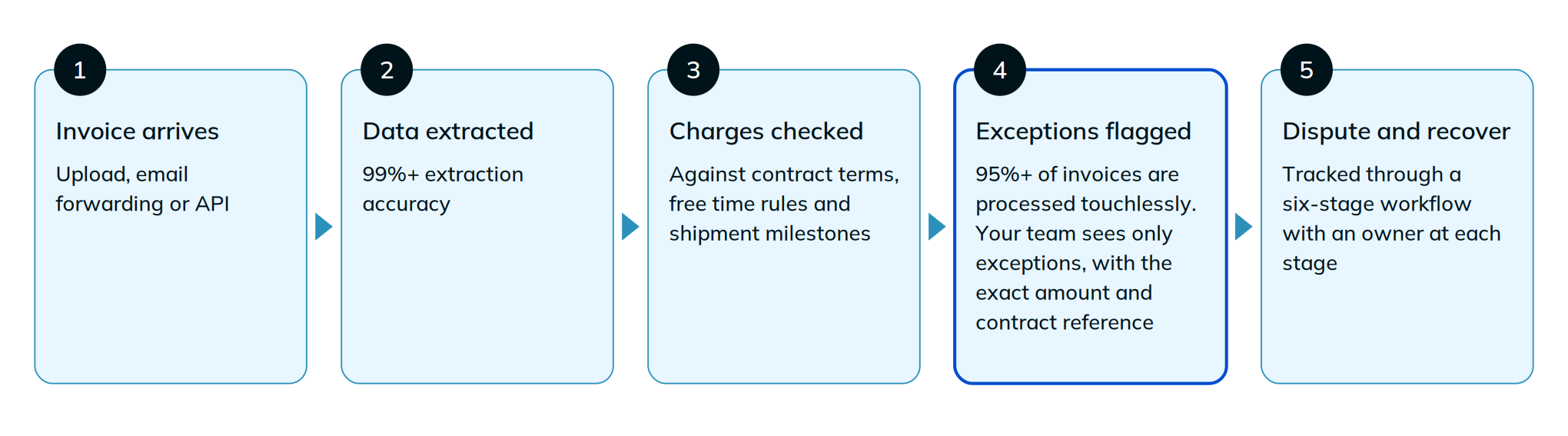
The solution: Portcast automates freight invoice auditing and helps prevent unnecessary costs. Portcast freight audit software extracts invoice data with 99%+ accuracy and processes more than 95% of invoices touchlessly. Each charge is automatically checked against agreed contract terms, free time rules and actual shipment milestones to identify discrepancies, unexpected fees and incorrect charges. Instead of checking every invoice line by line, your team focuses only on flagged exceptions. Each dispute comes with the exact amount in question and the relevant contract reference, making it easier to challenge incorrect charges and recover costs. Less manual work, fewer missed discrepancies and better control over freight spend.
The number: In a 90-day audit for a leading manufacturer across 20+ carriers, about 50% of invoices held at least one SLA or contract-level discrepancy, and 95%+ of flagged items were confirmed as legitimate disputes by the customer's team. Customers have seen up to 30% cost savings, and audit time falls by up to 10X.
Prioritising Your Logistics Tech Budget: Forwarders vs BCOs
Forwarders and BCOs may invest in the same four technology areas, but their priorities differ.
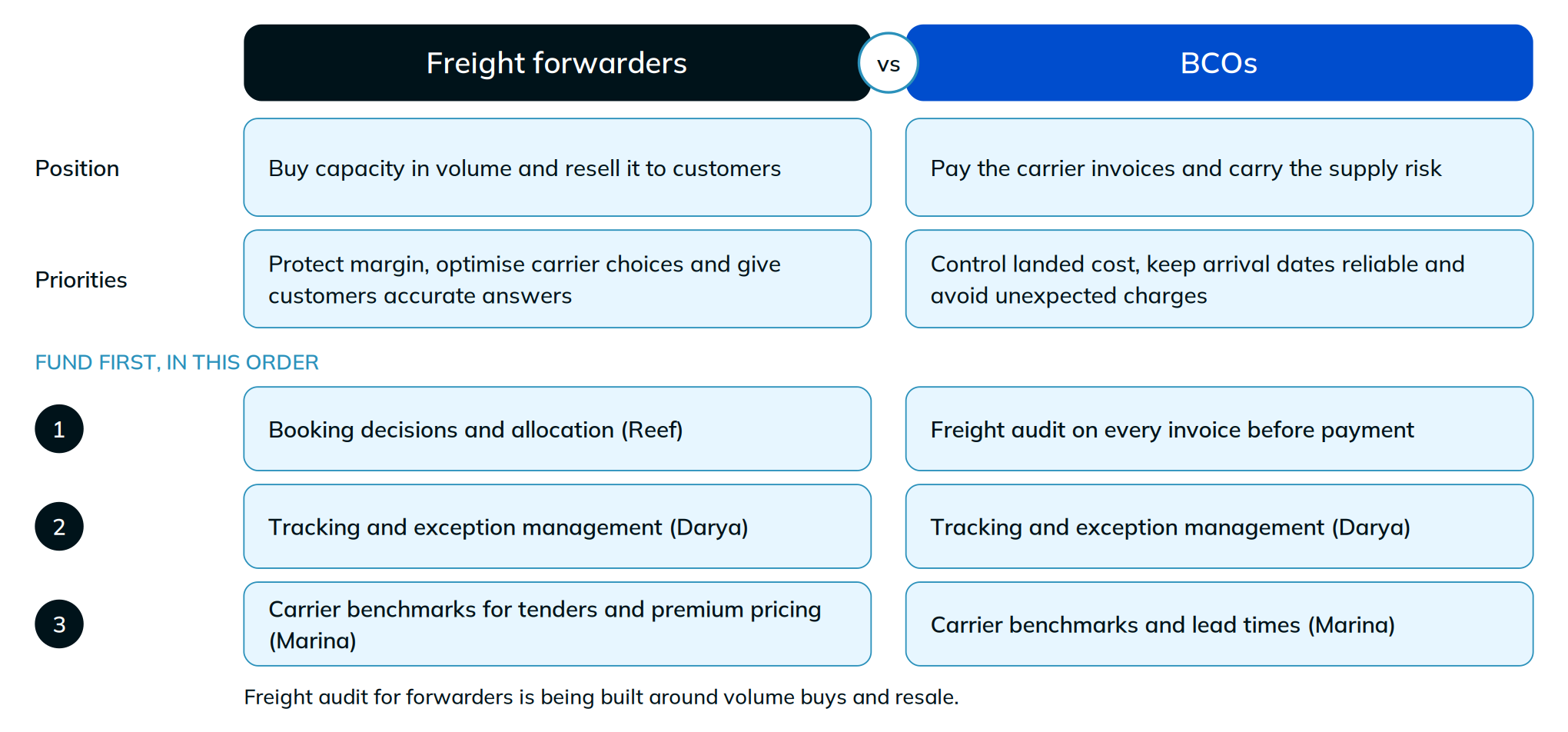
Freight forwarders buy capacity in volume and resell it to their customers. Their priorities are therefore protecting margins, optimising carrier choices and providing accurate answers to customers.
BCOs (Beneficial Cargo Owners) pay the carrier invoices and carry the supply chain risk themselves. Their priorities are more directly focused on controlling landed costs, ensuring reliable arrival dates and avoiding unexpected charges.
The technology may be the same, but the business drivers and purchasing priorities are different.
Freight Forwarders: Protect Margin and Answer Customers First
Freight forwarder software pays back fastest where it protects margin and shortens the customer call.
- Booking decisions and allocation. You buy capacity in volume, so every blanket booking and every unused allocation hits your margin. Reef ranks sailings on your priorities and shows planned allocation against actual use.
- Tracking and exception management. Rollovers and slipping ETAs often surface when customers call. A daily brief for each operator, or for each customer an operator handles, lets you update customers first. You can also give customers live tracking through the API, branded tracking pages or a white-labelled platform.
- Carrier benchmarks for tenders and premium pricing. Marina shows whether a faster service runs on time on that lane before you price it as premium.
Portcast has freight audit for forwarders around volume buys and resale. If carrier overcharges across your book are a priority, tell the team how your buy and sell work.
BCOs: Control Landed Cost and Arrival Dates First
For BCOs, supply chain visibility software pays back when it moves cost and lead time.
- Freight audit. You pay the invoices, so every contract term you negotiate needs checking on every invoice before payment. This is the line with the clearest cost recovery metric.
- Tracking and exception management. Early risk alerts let you line up pickup, customs and production planning, and the daily brief shows where D&D is building.
- Carrier benchmarks and lead times. Marina bases lead times on measured transit time, including multi-leg routes, so buffers fit what carriers deliver. BCOs that book directly with carriers can also use Reef to compare options before they commit.
AI Agents for Logistics: Where to Invest in 2027
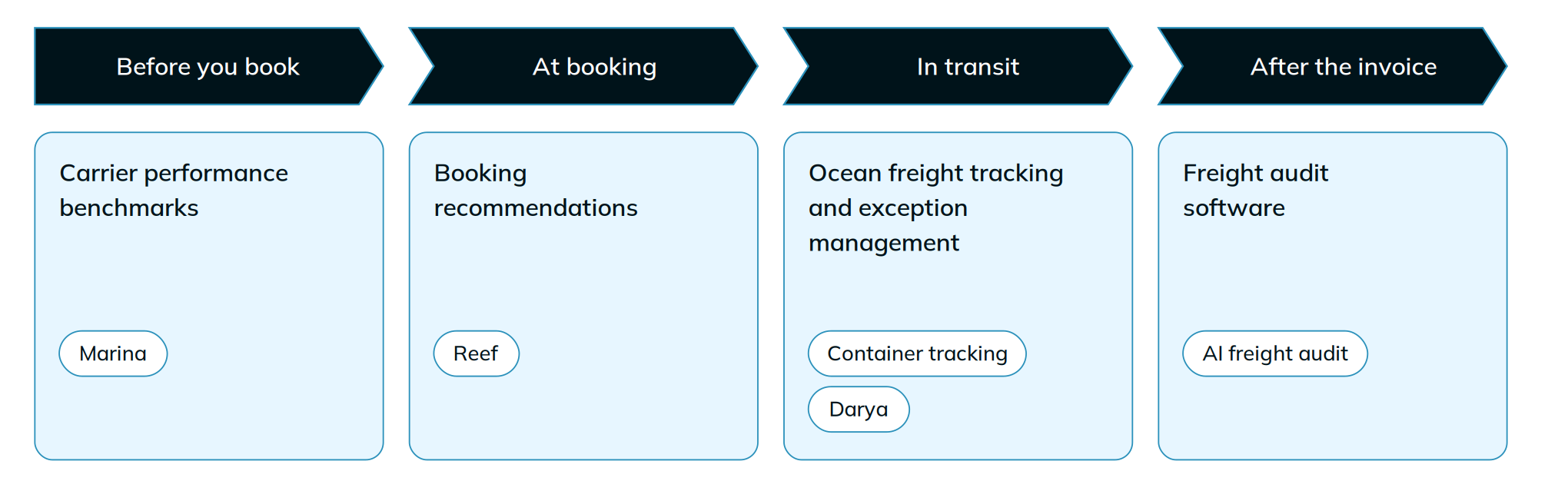
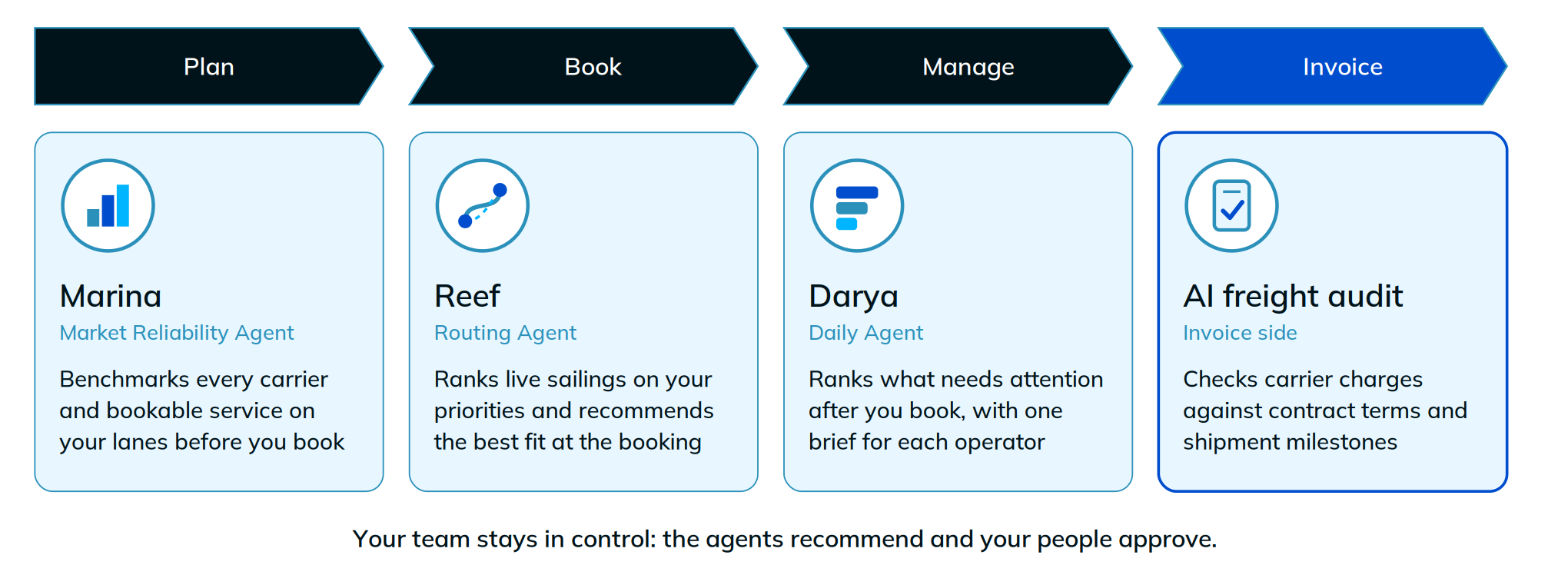
AI belongs in the 2027 budget where it takes over repeat work and recommends the next action. Portcast's agents cover three points: Marina benchmarks carriers before you book, Reef recommends sailings at the booking and Darya ranks what needs attention after you book. AI freight audit covers the invoice side.
Forwarders: Let AI Agents Run Operations and Customer Updates
- Operational automation. Darya reviews every shipment overnight and replaces manual status checks with one ranked brief for each operator. Reef cuts the manual research behind each booking.
- Customer service. Where an operator handles one customer, Darya's brief works as a daily report for that customer, so you update customers before they call.
- Procurement intelligence. Marina benchmarks every carrier and bookable service, so tenders and capacity decisions start from delivered performance.
- Margin protection. AI freight audit checks carrier charges against contract terms and shipment milestones. Portcast develops it around forwarder workflows, so tell the team how your buy and sell work.
BCOs: Let AI Agents Watch Risk and Cost
- Cost control. AI freight audit extracts invoice data with 99%+ accuracy, processes 95%+ of invoices touchlessly and sends you only the exceptions to challenge.
- Supply chain visibility. Darya monitors shipments, flags risks and recommends the next step before a delay reaches your operation.
- Carrier intelligence. Marina benchmarks reliability by lane and service and compares your contracted carriers with the lane average.
- Booking optimisation. Reef scores sailings on reliability, arrival, disruption, price and allocation, for BCOs that book directly with carriers.
The common opportunity is AI agents that continuously monitor shipments, identify risks, recommend actions and help teams decide. Your team stays in control, because the agents recommend and your people approve.
What to Cut in 2027
Three areas usually hold the most recoverable time and spend.
Manual Container Tracking Across Carrier Portals
Every status copied from a carrier portal into a spreadsheet is time spent on data entry.
Spreadsheet Invoice Checks
Manual freight invoice processing does not scale with volume, and every error a reviewer misses gets paid. Automated audits extract and validate every invoice, so your team reviews only flagged exceptions. Audit time falls by up to 10X, which frees analysts to run disputes with exact amounts and contract references.
Overlapping Alerts and Unused Reports
Alerts that fire one rule at a time flood you with notifications and don't show which one comes first. If two or three tools send overlapping alerts, keep the one that ranks them by urgency and business impact and cut the rest. Apply the same rule to reports that nobody opens between monthly reviews.
Conclusion: Run 2027 From One View
A 2027 budget works best when the funded tools come together in one place. Portcast's Command Center gives your team a single live view of every shipment, combining operational exceptions such as delays, rollovers and free time deadlines with external risks such as weather, strikes and geopolitical events. You set the thresholds for what counts as at risk, so the view shows only what matters to your business, and each exception opens with the affected containers, a map and suggested next steps. Add Darya, the Daily Agent, and every operator starts the day with one ranked brief built on the same thresholds, turning the morning review into a routine that takes about 10 minutes per operator. For the global food manufacturer above, that meant avoiding about $300k in D&D charges each year and cutting morning review time from 45 to 10 minutes per operator (Portcast estimates). Together they give finance a clear, measurable return for 2027.
Interested in learning more about how Portcast can help your logistics? Contact us.
Frequently Asked Questions
What should an ocean freight tech budget include for 2027?
Include four areas: carrier reliability benchmarks for tenders, exception management, freight audit and booking recommendations. Each line should change a decision, and you should be able to measure its result in money or hours.
How do I show ROI on freight technology to finance?
Pick one metric for each tool, such as D&D charges avoided or recovered invoice value, and record a baseline before rollout. A 90-day pilot on one lane then gives finance a result from your own data.
Which freight technology costs should I cut first?
Cut manual tracking across carrier portals, spreadsheet invoice checks and overlapping alert tools first. They use analyst time, miss errors at volume and send alerts without ranking them.
How is a freight forwarder's tech budget different from a BCO's?
Forwarders buy capacity in volume and resell it, so booking decisions, allocation and customer updates drive margin. BCOs pay carrier invoices and carry the supply risk, so freight audit, early risk alerts and lead times drive landed cost. Both benefit from carrier benchmarks and exception management.
How can I reduce demurrage and detention charges in 2027?
Watch free time on every container. Port terminal data shows Last Free Day and pickup availability, and a ranked daily brief flags containers with free time running down. Then audit demurrage charges against actual shipment milestones to dispute any that do not match what happened.