The Company
A global food and ingredients manufacturer moving a high volume of ocean freight across Asia-origin export lanes through multiple freight forwarders. Ocean freight invoices arrive from several forwarding partners in different formats, carrying ocean freight, accessorial, and spot charges that must be checked against negotiated contract rates before payment. With hundreds of invoices flowing in each month across two primary forwarders, keeping billing accurate and disputes defensible is a core finance and logistics responsibility.
The Challenges
Checking freight invoices meant manual reconciliation on spreadsheets, matching invoices to container lists through Excel and VLOOKUP reports. It ate significant time each month, scaled poorly as volume grew, and still couldn't catch everything before payment went out.
Overcharges slipping through to payment
Forwarders sometimes billed above the agreed contract rate due to human error, and with no line-by-line check against the contract, those overcharges were paid rather than disputed. Each one was small enough to miss and frequent enough to add up.
Invoices getting stuck and holding up payment
Plenty of invoices were correctly priced but still could not be paid cleanly, held up by a missing plant number, an absent system reference, or an invoice issued past the agreed cutoff. Spotting these across hundreds of invoices wasn't realistic, so problems surfaced late, and payment stalled. That created friction, and in the worst cases risked a supplier placing the account on stop.
No quick way to build a dispute
When a charge did look wrong, challenging it meant manually digging out the contract rate, the billed amount, and the difference for that specific charge. That legwork took long enough that smaller discrepancies were often not worth chasing, so money that could have been recovered was written off by default.
The Solution
Portcast worked closely with the team to define audit rules specific to their contracts and to identify where contract definitions and invoice data needed to be extended for accurate matching.
AI Document extraction
AI-powered extraction reads freight invoices and contracts across multiple forwarders and formats, converting them into structured, auditable data with no manual re-keying.
Automated audit
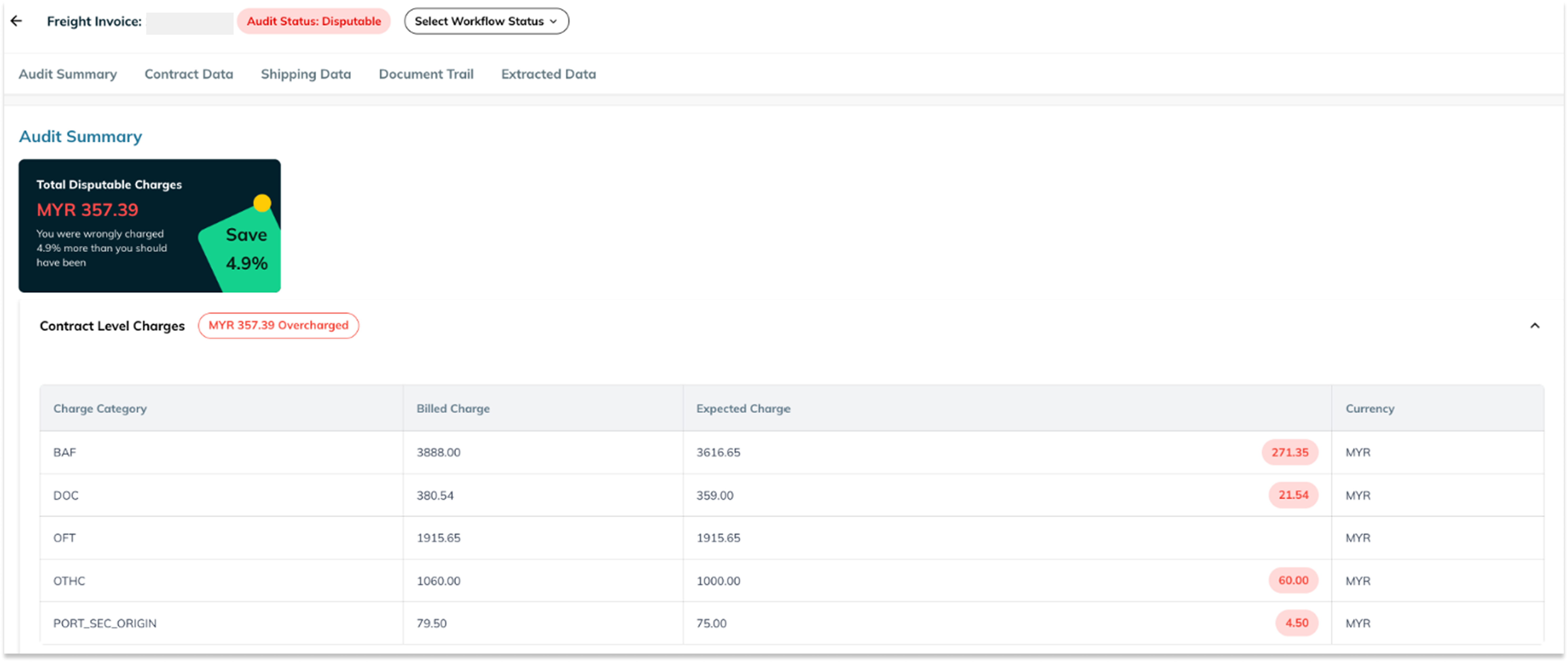
Every charge line on each in-scope invoice is compared to the negotiated contract, and discrepancies are flagged and categorized: overbilling, underbilling, charges outside contract scope, and business-rule validation failures, each with the specific charge category and figures behind it.
Dispute-ready output
Each flagged invoice comes with the exact charge, the expected contract rate, and the difference, so a billing challenge can be raised without manual case-building.
The Impact
Across a single audit run covering 488 invoices submitted over roughly three months, Portcast moved the team from manual, after-the-fact checking to structured, quantified billing oversight.
- Surfaced approximately USD 20,250 of overbilling as recoverable exposure across 36 invoices, where forwarders billed above contract rates, alongside roughly USD 9,400 of underbilling identified across 28 invoices, for a net of USD 10,850 billed over contract on the audited set.
- Flagged approximately USD 40,600 of gross invoice value at risk of delayed payment across 40 invoices where charges matched the contract but a business-rule validation failed, such as missing mandatory metadata, a missing system reference, or an invoice issued past the agreed cutoff.
- Audited every charge line automatically against contract terms, replacing the manual comparison the team previously performed and giving each flagged invoice a clear, dispute-ready breakdown.
- Cut manual invoice processing time by around 95%, shifting from Excel and VLOOKUP reconciliation to automated extraction and auditing. Across the roughly three-month run, that freed close to USD 10,000 in staff time, redirected away from line-by-line manual checking.
- Pinpointed exactly where contract coverage and invoice data needed to widen, turning previously un-auditable invoices into a clear remediation path for lifting the share of invoices that can be audited over time.
- Uncovered and fixed process gaps beyond the invoices themselves: correcting how charges were scoped so per-container and per-bill-of-lading rates matched correctly, resolving a data issue where stale duplicate contract rows were overriding the correct rates, and delivering a written dispute-handling procedure the team could follow.
Curious how Portcast can cut manual tracking, improve shipment visibility, and reduce costs? Get in touch to explore how.