%201.svg)
A Note: Why Freight Audit Needs a Rethink
Most of the time, when freight audit is discussed, it's retrospective by default. The invoice comes in, you match it with contract data, and check if everything is okay. That's it.
Discrepancies don't just lie in how the contract is applied. They lie in the ground truth. How many days did the container spend at the port? Why was there a delay? Was a pickup slot available? Was the carrier responsible? All of this decides whether you should pay the invoice. Or whether you should be invoiced at all.
The BCOs we work with fall on a different maturity spectrum. Some are really proactive. They raise concerns and solve disputes even before getting invoiced. Carrier rolls over a container? They flag it right there and say, "We're not paying D&D on this shipment". Some are still defining the internal process for the freight audit itself. Others have already identified ~5% of extra savings left on the table by using a solution that connects visibility to an automated AI-based freight audit.
This report breaks down exactly where invoice leakage occurs, why traditional audit processes are structurally insufficient, and what it looks like to build an audit process that collects evidence and ground truth during the shipment journey, not after you receive the invoices.
- Urvesh Devani, VP of Technology, Portcast
1. Understanding Freight Invoices: The Anatomy
For any given shipment, the billing process involves three independent data streams that all need to align:
Carriers' invoices are based on their own records. Without automated cross-referencing among all three layers, a BCO largely takes the invoice at face value. That is a costly assumption.
Where Cost Leakage Hides: Real Categories
Based on Portcast's freight audit work with large BCOs across manufacturing, these are the most common sources of invoice leakage:
👉 On SLA rules: Most BCOs have a detailed set of invoice compliance rules negotiated into carrier contracts, covering billing entities, timing windows, charge separation, mandatory fields, and tax treatment. In practice, very few companies check all of these on every invoice. Portcast ingests the full SLA rule set and auto-validates every invoice on receipt. SLA violations alone, independent of any rate discrepancy, are grounds for outright dispute.
2. Why Manual Audits Cannot Keep Up with Freight Complexity
Manual freight audit is architecturally mismatched with the complexity and volume of modern freight billing.
This is what a manual audit process looks like in practice:
- Receive invoice: Manually extract line items into a spreadsheet
- Pull the contract file: Cross-reference rate by lane, container type, and date, manually
- Check SLA rules: If remembered: billing entity, timing windows, mandatory fields
- Compare with shipment data: Typically skipped. Tracking data lives in a separate system.
- Raise a dispute: Email the carrier or forwarder, wait, follow up, track manually
At scale, hundreds of invoices per month across multiple carriers, lanes, currencies, and container types, this process breaks down. Teams audit a fraction of what arrives, spot-check by exception, and absorb the rest.
The deeper issue is timing. By the time an invoice arrives, the journey is over. The opportunity to prevent the charge by disputing a carrier-caused delay or flagging a container as at risk is already gone.
👉 The audit itself starts during the journey, not when the teams receive the invoices. By the time the invoice is received, it is already too late.
3. Assessing Your Freight Audit Maturity: Where Do You Stand?
Not all BCOs are at the same level of freight audit maturity. Based on Portcast's onboarding and benchmarking work across customers from different industries, most organizations can be assessed across five dimensions:
Most organizations, including those with significant freight spend, score low on at least three of these dimensions. The gap is often invisible until someone starts counting the errors.
An Example: How Portcast Transforms Audit Maturity
The table below highlights maturity outcomes for one of our manufacturing customers.
The company has been using Portcast’s Freight Audit solution since late last year, and there is still clear scope to improve their scores across most of these dimensions in the near term.
👉 At 4/5 on touchless audit process: 97% or more of invoices are processed without any manual intervention. The remaining 3% are handled via a feedback loop that continuously improves the model. When the company started at 1/5 or 2/5 across most dimensions, it meant the invoices were reviewed manually with no SLA enforcement, no shipment data linkage, and no live D&D monitoring. This is the starting point for a significant share of mid- to large BCOs.
4. From Cost Leakage to Prevention: How Portcast Audits Freight
Portcast's freight audit capability works across three interconnected stages, each targeting a different moment in the cost leakage lifecycle.
Stage 1: In-Journey Cost Prevention
The highest-value intervention happens before any invoice is issued. Portcast monitors live shipments against contracted D&D terms in real time, surfacing exposure before it becomes a charge.
Example: D&D Risk Flagged Before Charge Accrues
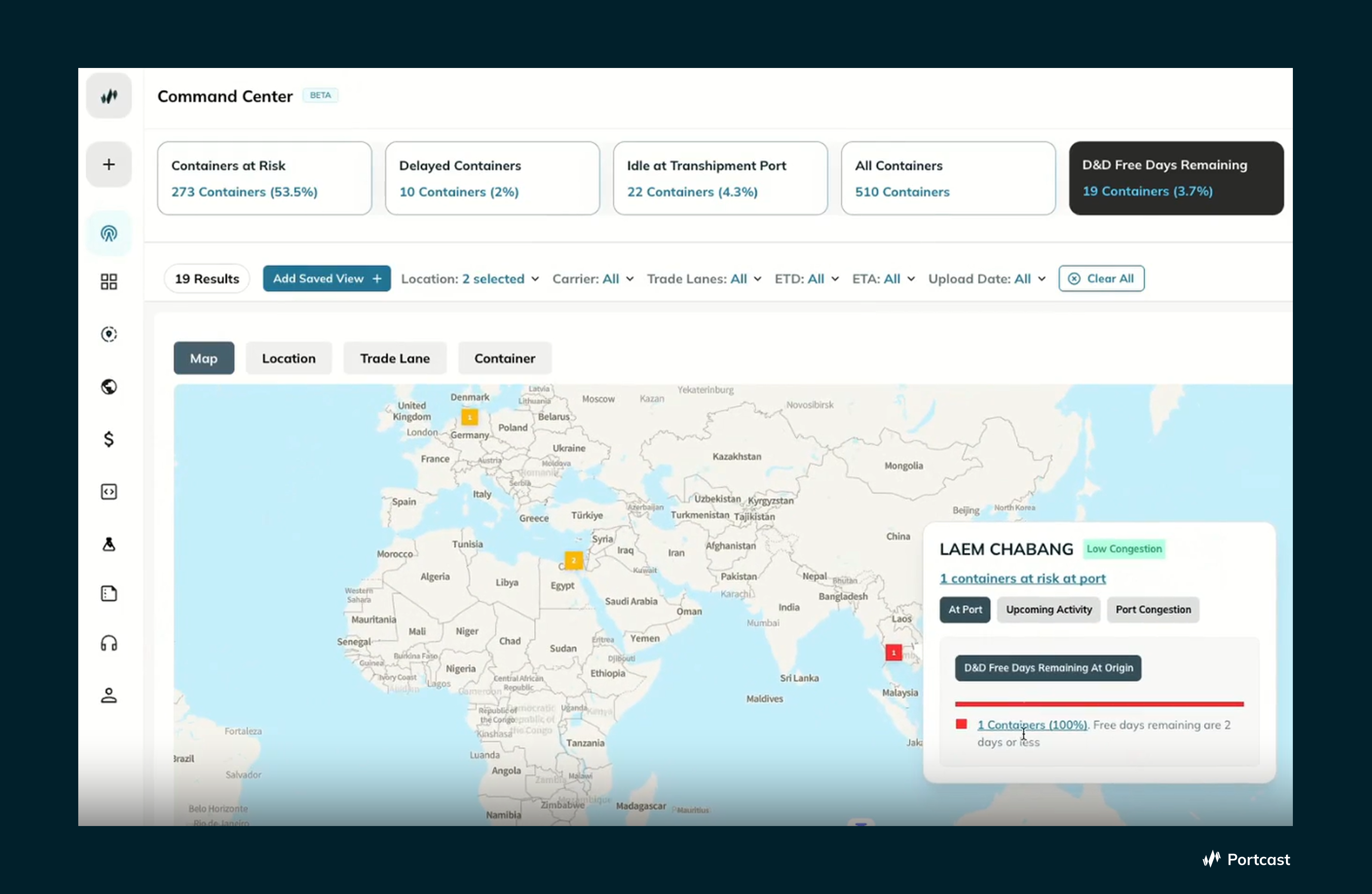
A container shipped from Laem Chabang, Thailand, to Auckland picked up an empty unit on 7 March. Under the contract, 14 combined free days apply from empty pickup. By 18 March, 11 days had elapsed, leaving just 3 days before D&D charges begin.
Portcast's command center flagged this as a live risk. The departure was scheduled for 19 March, but given port conditions, that window was uncertain. The team confirmed with the carrier before the free-day window closed. The charge was prevented before it ever accrued.
Another Example: Carrier Rollover, Dispute Filed Before Invoice Issued
Two containers showed $630 in accruing D&D at origin. Portcast cross-referenced shipment data and identified a carrier-caused rollover, resulting in a 6-day delay. Under the contract, 3 free days were allowed; the containers had been at port for 10 days, generating $315 per container.
Portcast matched the rollover event against the contract terms. The logistics team contacted the freight forwarder directly: the delay was the carrier's fault, and no D&D invoice should be issued. The invoice was never generated. The charge never hit the books.
This is what makes Portcast structurally different from invoice-only audit tools: the audit starts the moment a container begins its journey, not when a PDF arrives in a finance inbox.
Stage 2: Automated Invoice Audit
When invoices arrive, Portcast's AI-powered document parsing captures every line item without manual data entry. The audit runs automatically across three layers:
Example: Rate Mismatch
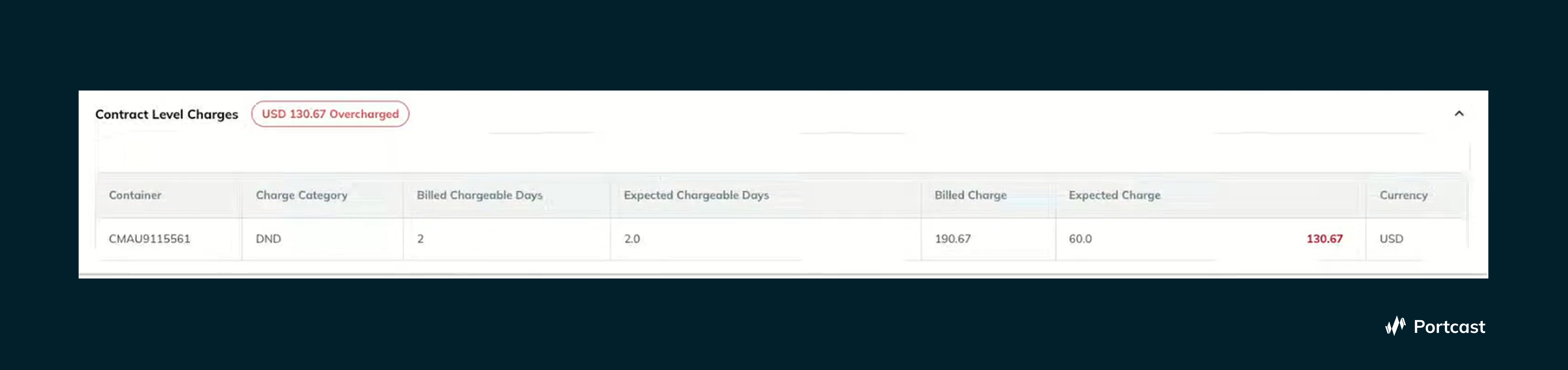
An invoice arrived for a container that spent 2 extra days at the port. The carrier billed $190 for detention. Contracted rate for that lane and container type: $30 per day. Correct charge: $60. Dispute raised. $130 recovered.
Stage 3: Dispute Workflow and System Integration
Once a disputable charge is identified, Portcast triggers the appropriate workflow. Dispute packages, audit trails, and back integration to SAP or ERP mean that findings flow directly into existing finance and procurement systems. No re-entry, no dropped disputes, and no parallel tracking.
For customers not using Portcast's visibility product for shipment tracking, the platform supports BYOD (Bring Your Own Data), pulling shipment data via integration from existing TMS or internal systems. Audit quality is the same.
5. Portcast in Practice: A Real Customer Example
The following reflects Portcast's actual audit performance over a 90-day period for a leading manufacturing company operating across different geographies.
90 Days of Audit Data, Savings of ~5% of the Invoiced Cost
👉 What this tells you: Across thousands of invoices, roughly half contained a disputable charge. At 95%+ accuracy, this is not noise. It reflects a systemic billing environment where errors, whether on rates, SLA rules, or D&D calculations, are the norm rather than the exception. The question is not whether your invoices contain errors. It is how many of them you are currently catching.
The Numbers: What Automated Freight Audit Delivers
The KPI comparison below reflects measured outcomes from Portcast's freight audit implementation with a large logistics-intensive manufacturer shipping across multiple global trade lanes.
👉 The negotiation dividend: Every disputed invoice creates a data point. Over time, Portcast builds a structured record of carrier billing behavior: how often charges are wrong, which lanes generate the most disputes, and where carriers consistently overbill. At contract renewal, procurement teams are no longer arguing from memory. They have documented evidence. This is a dimension of freight audit that most BCOs are not currently leveraging.
6. What This Transformation Means for Your Role
Freight audit affects different parts of an organization in different ways. Here is how the shift to automated audit changes things across the three roles most directly affected:
7. Evaluating a Freight Audit Solution: Key Questions to Ask
If you are assessing automated freight audit options, these questions are a must-ask:
8. Conclusion: Every Month Without This Is Recoverable Money Left Behind
Freight invoice errors are not anomalies. They are a structural feature of a billing system that is high-volume, multi-party, and largely manual on both sides. Most large shippers are absorbing a percentage of their freight spend that they should not be, not because they are not paying attention, but because the tools they have are not built for the scale or complexity of the problem.
The shift from reactive audits to preventive, automated freight audits is not merely a technology upgrade. It is a change in when and how you engage with cost: from after-the-fact recovery to in-journey prevention.
The invoice is the last place to catch errors. The earlier you move the intervention point, the more you recover and the less you ever pay in the first place.
Is there recoverable value in your freight invoices right now?
Portcast's freight audit module is built on the same shipment data infrastructure that powers real-time container visibility, meaning every audit draws on actual journey data, not just document data. If you are auditing invoices manually or using a tool that does not cross-reference shipment events, there is almost certainly money in your invoices that has not been recovered.
👉 If you are looking to automate your freight audits and recover costs, speak to the Portcast team.