Every booking is a routing decision. Most teams make it without comparing the right options.
Reef, the Routing Agent, searches live sailings and scores every option against your criteria. It combines market data, such as carrier and service-level reliability, transit time, transshipments and live disruption, with your own contracted carriers, rates and allocation. Your team gets a ranked recommendation with the reasoning shown, before anyone commits.
See it in action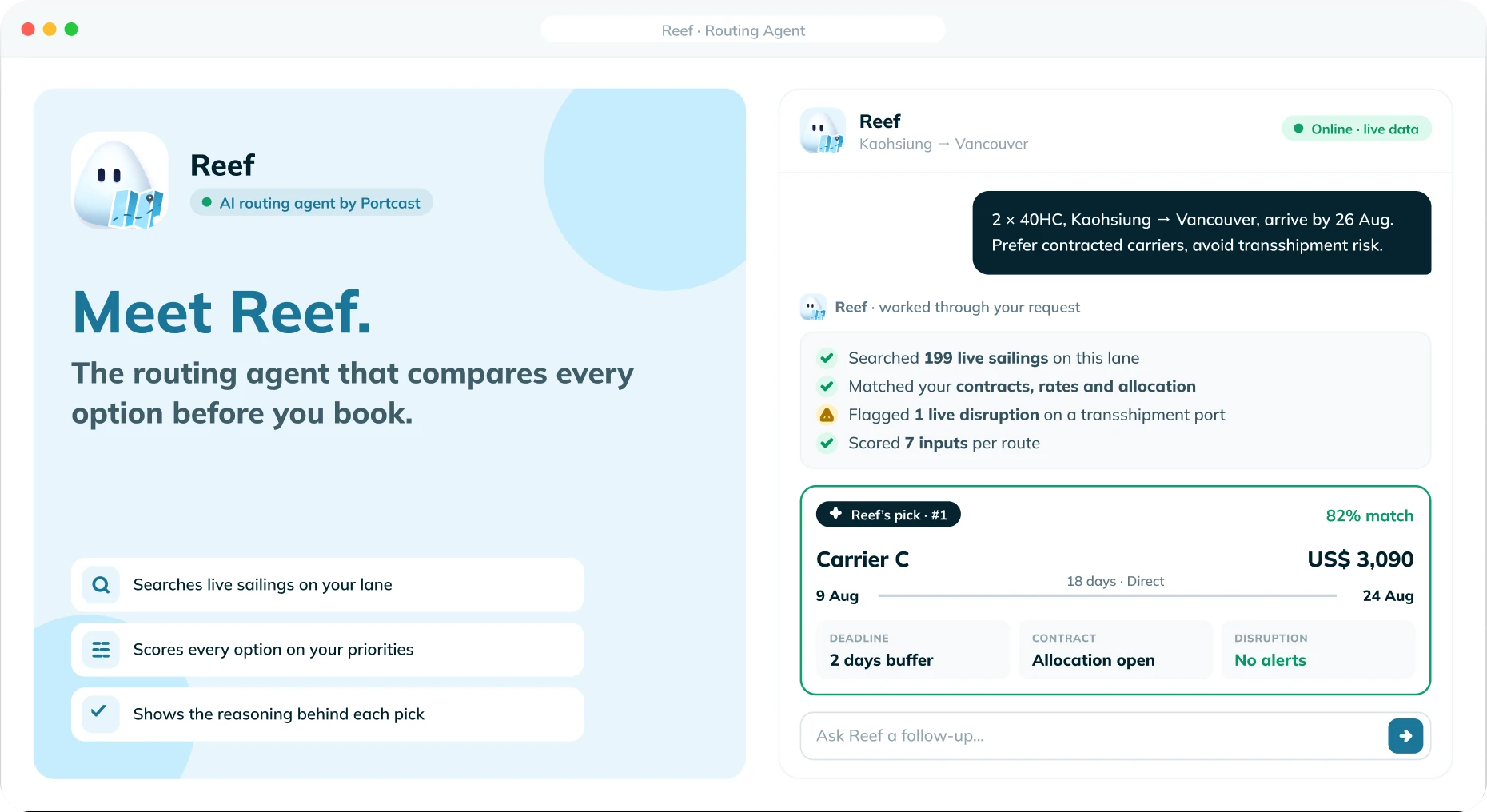
Why does booking the first available sailing cost you?
Every booking decision comes with consequences. A sailing that looks cheaper or readily available can run through a congested hub and miss the customer’s delivery date, and the rebooking, air freight or missed shelf date that follows can cost far more than the saving. The information needed to choose well sits in carrier websites, allocation contracts, rate systems and spreadsheets, so with limited time most operators run one or two quick checks and book. The same pressure returns after a rollover, a blank sailing or a port closure, when the team has to re-plan quickly.

Booked on what is available
When no tool compares routes against the full set of inputs, operators default to whatever looks available, and they never evaluate the best option on the lane.

The allocation plan gets missed
Allocation is agreed per contract period, often quarterly or yearly, but how actual use compares with the plan is rarely in front of the person booking. Teams book blind or ignore the plan, so committed space goes unused or gets over-used.

Slips found late
Schedules change and bookings roll, often without notice, and the window to amend a booking is short. Teams that find out late end up with rebooking costs, emergency air freight or missed delivery windows.
What is Reef, the Portcast Routing Agent?
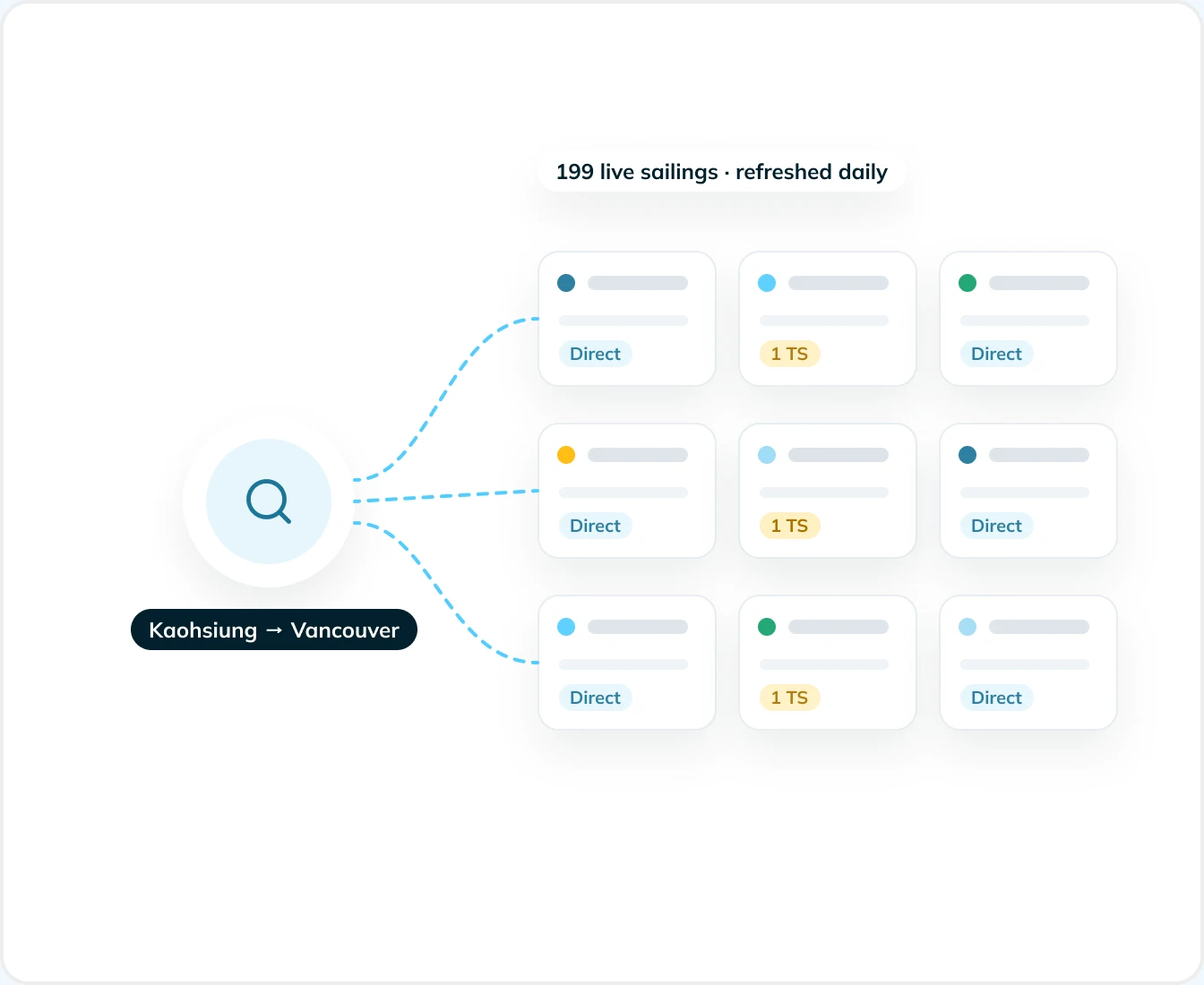
Reef is Portcast’s Routing Agent, an AI agent for ocean booking decisions. For a given lane, Reef searches live sailings, scores each option against your team’s scoring model, and gives your operators the top recommendations with a plain-language explanation. Each recommendation draws on market data, such as carrier and service-level reliability, transit time, transshipments, live schedules and disruption, together with your own contracted carriers, rates and allocation, so operators can make a booking decision in minutes.
Operators no longer waste time weighing every option or falling back on gut feel; even a quick decision rests on the full data set. Direct and transshipment options are compared side by side, so route comparison happens before the booking is placed, not after something goes wrong.

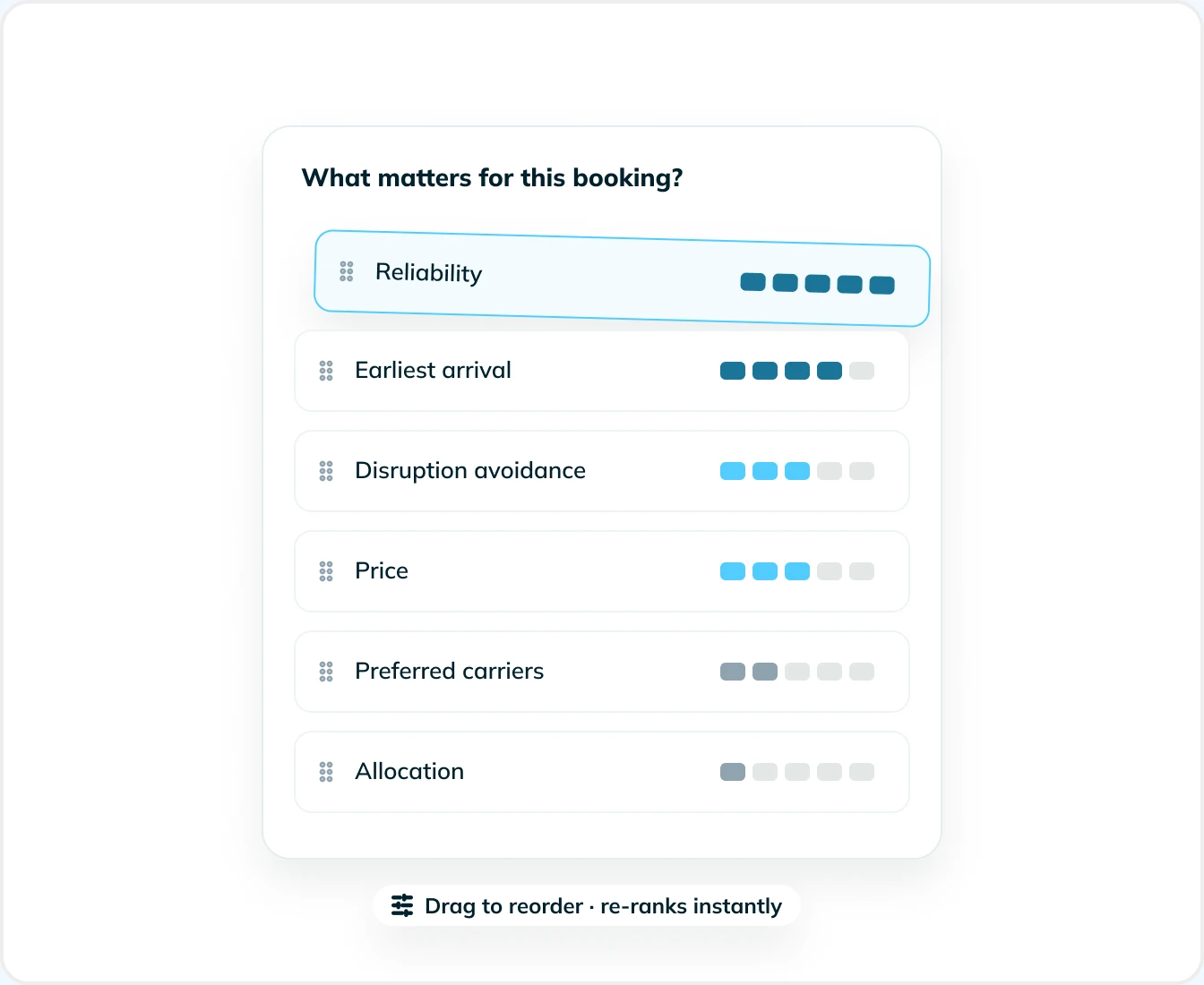
Priorities you rank for each booking
Put reliability, earliest arrival, disruption avoidance, price, preferred carriers or allocation in the order that matters for this shipment. The higher a priority sits in your ranking, the more it weighs, and every option is re-scored instantly, so a time-sensitive booking and a standard booking get different answers.

Evidence over claims
Options are ranked on observed carrier and service-level reliability and live schedule data, not carrier promises. Each view states how many sailings were scanned, where reliability comes from, when the data was last refreshed and which records were excluded.

Reasoning on every option
The ranked shortlist shows why each sailing sits where it does, and the alternatives stay on screen so the final call is yours.
What does Reef, the Routing Agent, do?
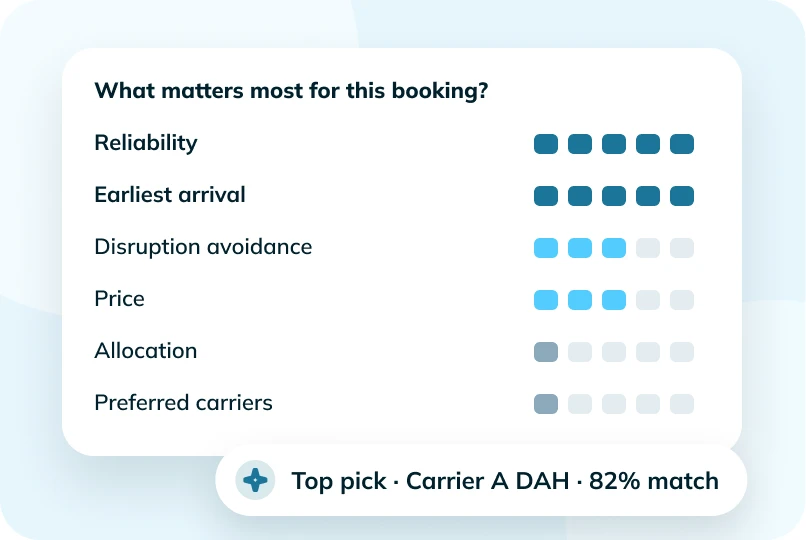
Compares every sailing on the inputs that matter
Each option is scored using market data (carrier and service reliability, transit time, transshipments, dwell risk and live disruptions) and your own data (rates, allocation agreements, contracted carriers and preferences), weighted by your priorities. For time-sensitive bookings, prioritize earliest arrival and reliability; for standard bookings, prioritize price.
Decisions made against the full set of inputs produce better results than decisions made on one or two variables, and the gain compounds across every booking.
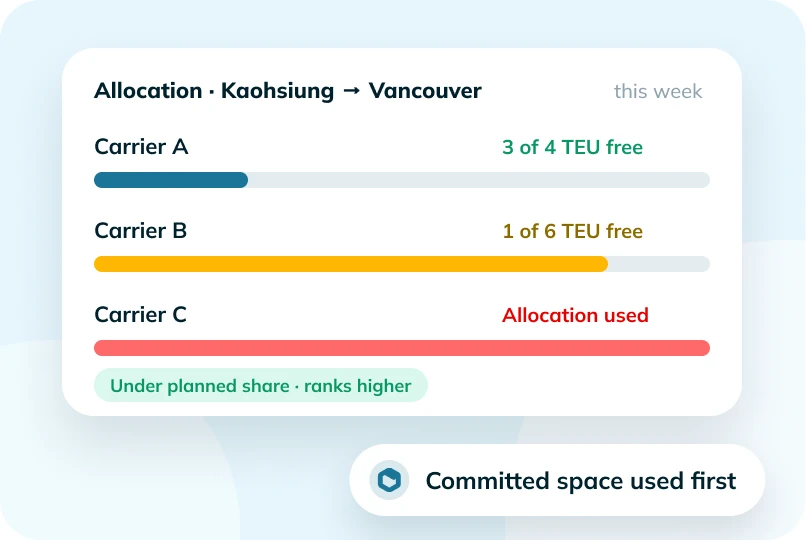
Keeps allocation in front of the person booking
Reef builds your planned allocation into the scoring, compares it with actual use, and shows how much remains for each carrier on the lane, so committed space is used first.
Under-used allocation pays for capacity that produced no value, and over-booking triggers penalties. Seeing planned and actual use at the point of booking helps prevent both.
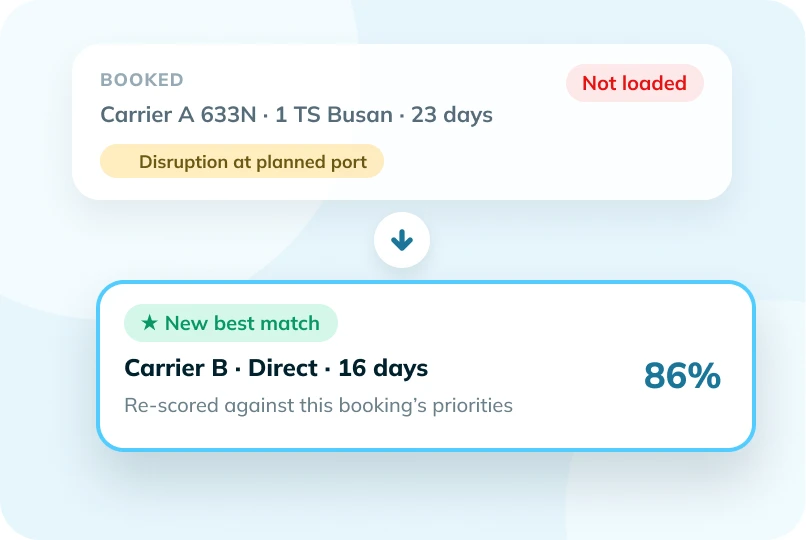
Re-ranks when the booking changes
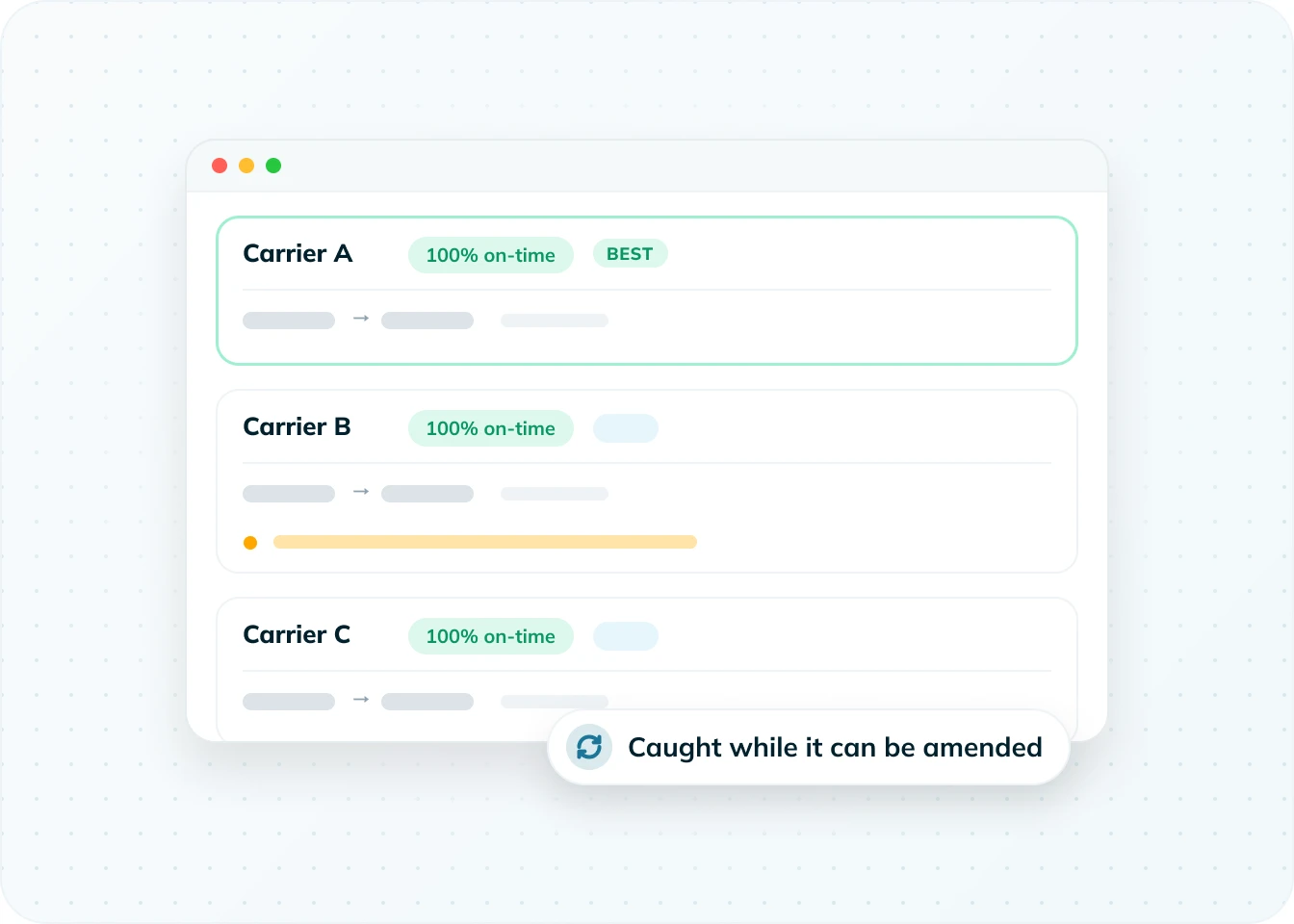
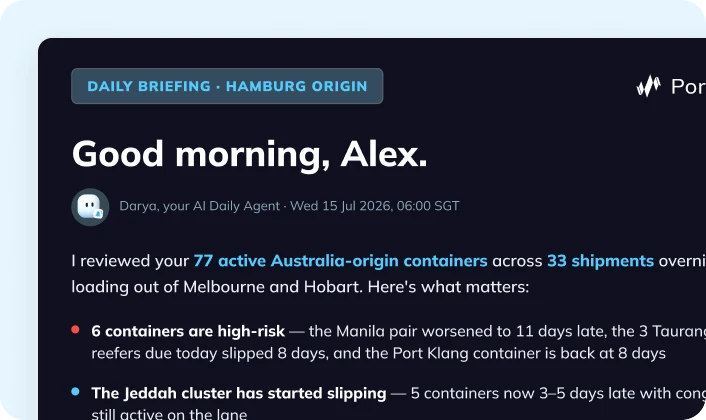
Each booking can be re-checked against live sailings and flagged if it slips. When a booked sailing rolls, the lane shifts or disruption hits the planned port, Reef re-scores every live sailing against your ranking and shows the best alternative. When Darya, the Daily Agent, flags a disruption, Reef can propose alternate sailings.
Risks to a booking are caught before cutoffs are hit, while action is still possible.
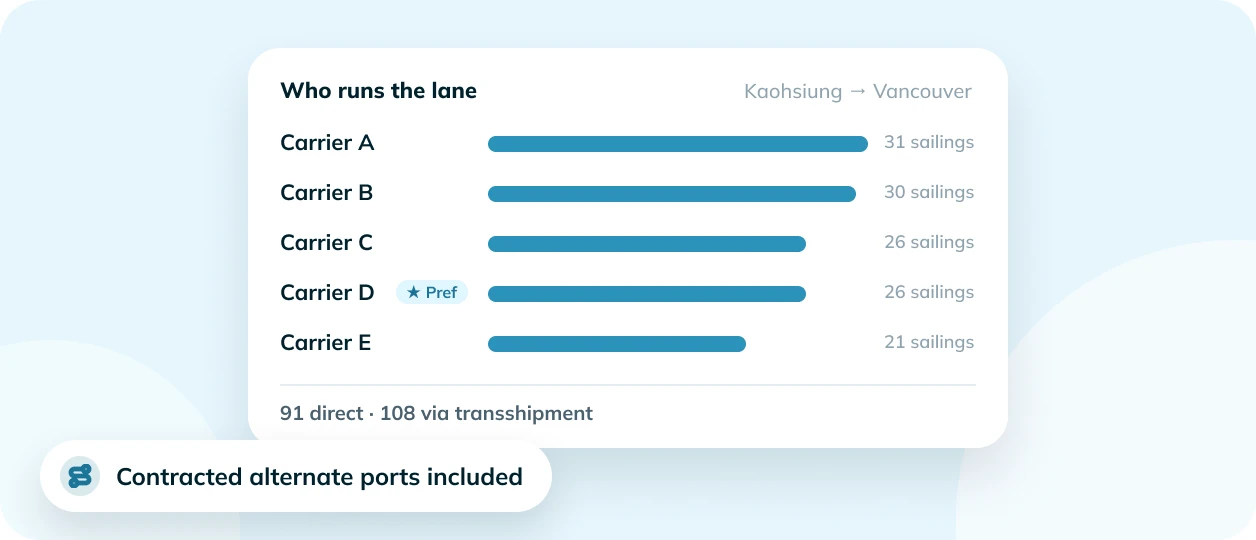
Shows the lane, its alternatives and its disruptions
See who runs the lane, the split between direct and transshipment services, and the best and worst performers. Reef also highlights disruptions that could affect the lane or a specific service, such as port congestion, weather incidents and geopolitical events. Alternate routings you have contracted, such as a different port of loading or discharge, are searched alongside the main lane and clearly labeled as alternatives.
Alternative routing and lane risks are visible in one comparison, without a manual search of carrier portals.
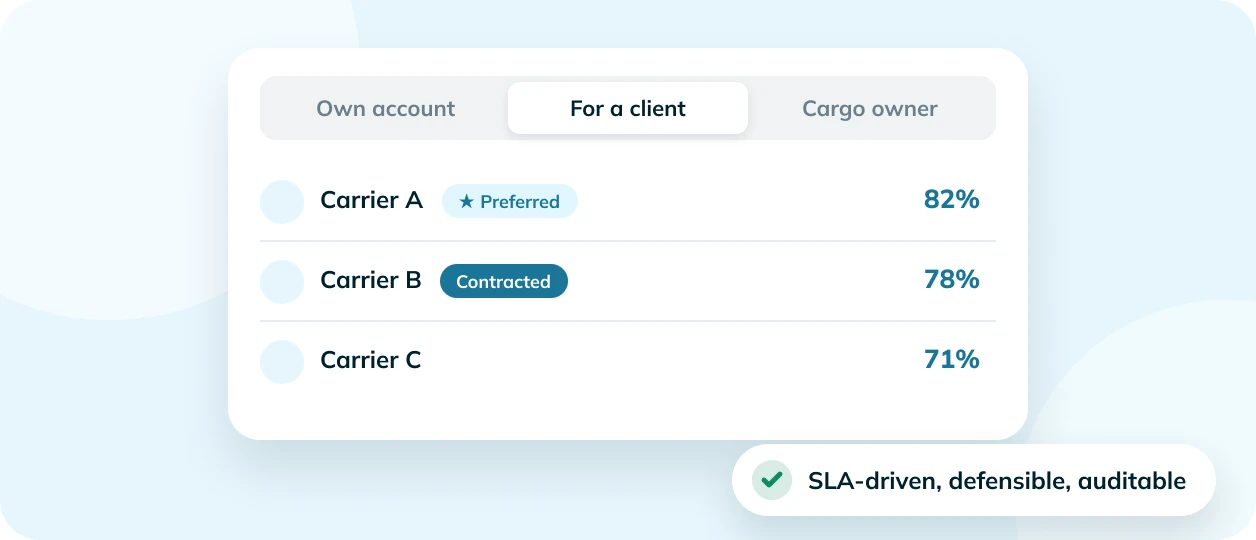
Fits how your team books
When you book for your own account, Reef helps you protect margin while meeting the service you promised. Managing routing for a client, you get every carrier ranked on evidence, with preferred and contracted carriers tagged, so recommendations are SLA-driven, defensible and auditable for the shipper you answer to. Cargo owners that place bookings themselves can use the same ranking to compare carriers and routes before committing.
One scoring engine serves forwarders and cargo owners, whichever way the booking is made.
How do operations teams use Reef, the Routing Agent?
Choosing which sailing to book
Operators check carrier portals one at a time, assemble options in a spreadsheet and book the sailing that looks available. Reliability and allocation are rarely in front of them.
The operator opens the top recommendations, ranked by the team’s scoring model, with the reasoning for each and the alternatives still on screen. The operator places the booking in minutes, with a rationale.

Better booking decisions, fewer downstream exceptions and consistent logic across operators.
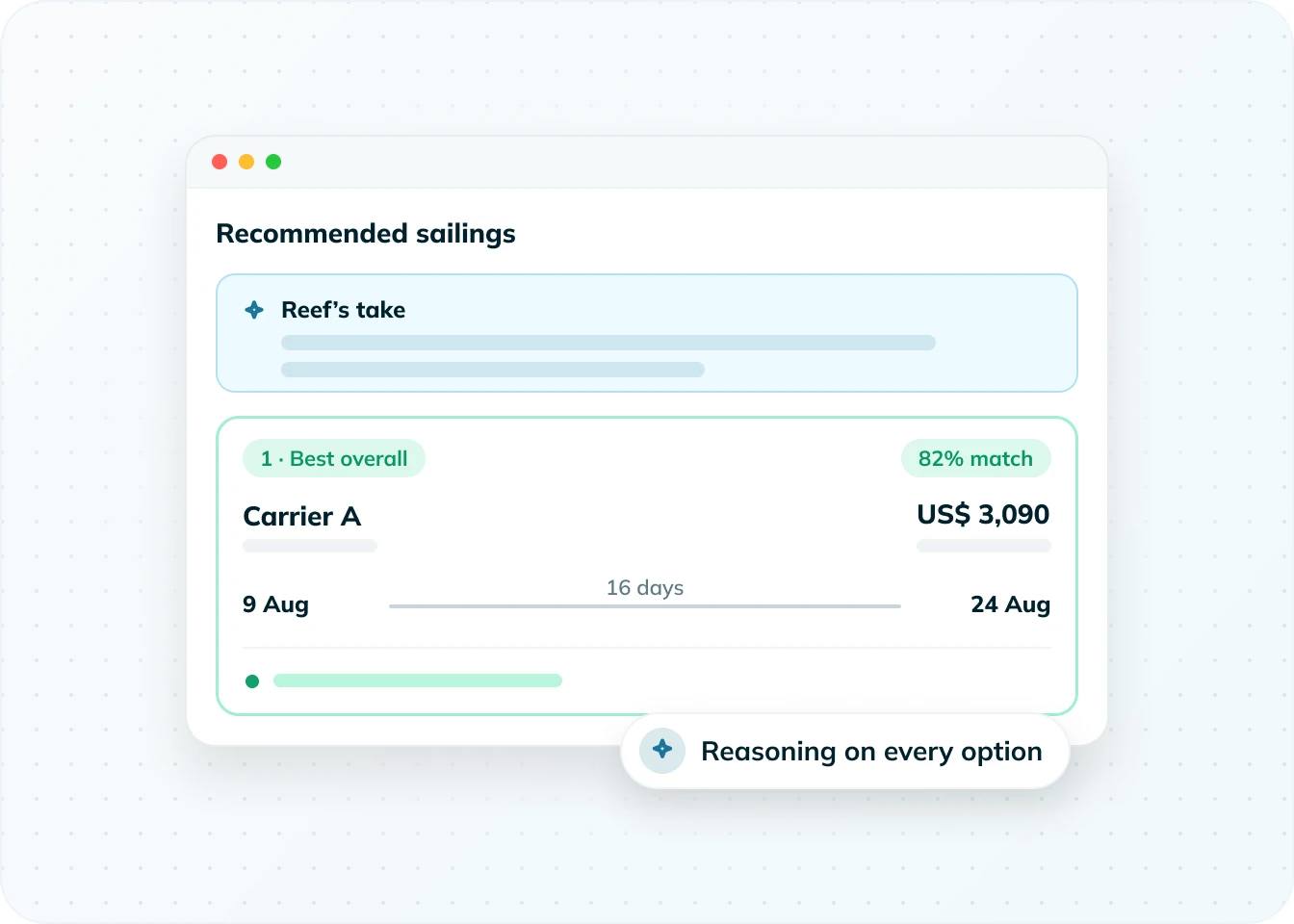
Rebooking after a rollover or disruption
A booked sailing rolls or a port is disrupted, and the team learns late. They rebuild the options manually while the window to amend the booking closes.
Reef re-scores every live sailing against the booking’s priorities. For example, it can show that the booked sailing has not yet loaded, that there is disruption at the planned shipment port, and that a direct service on another carrier is now the best match.
Slipped bookings caught 2 to 3 weeks earlier in the case study, while the booking can still be amended.
Following the allocation plan at booking
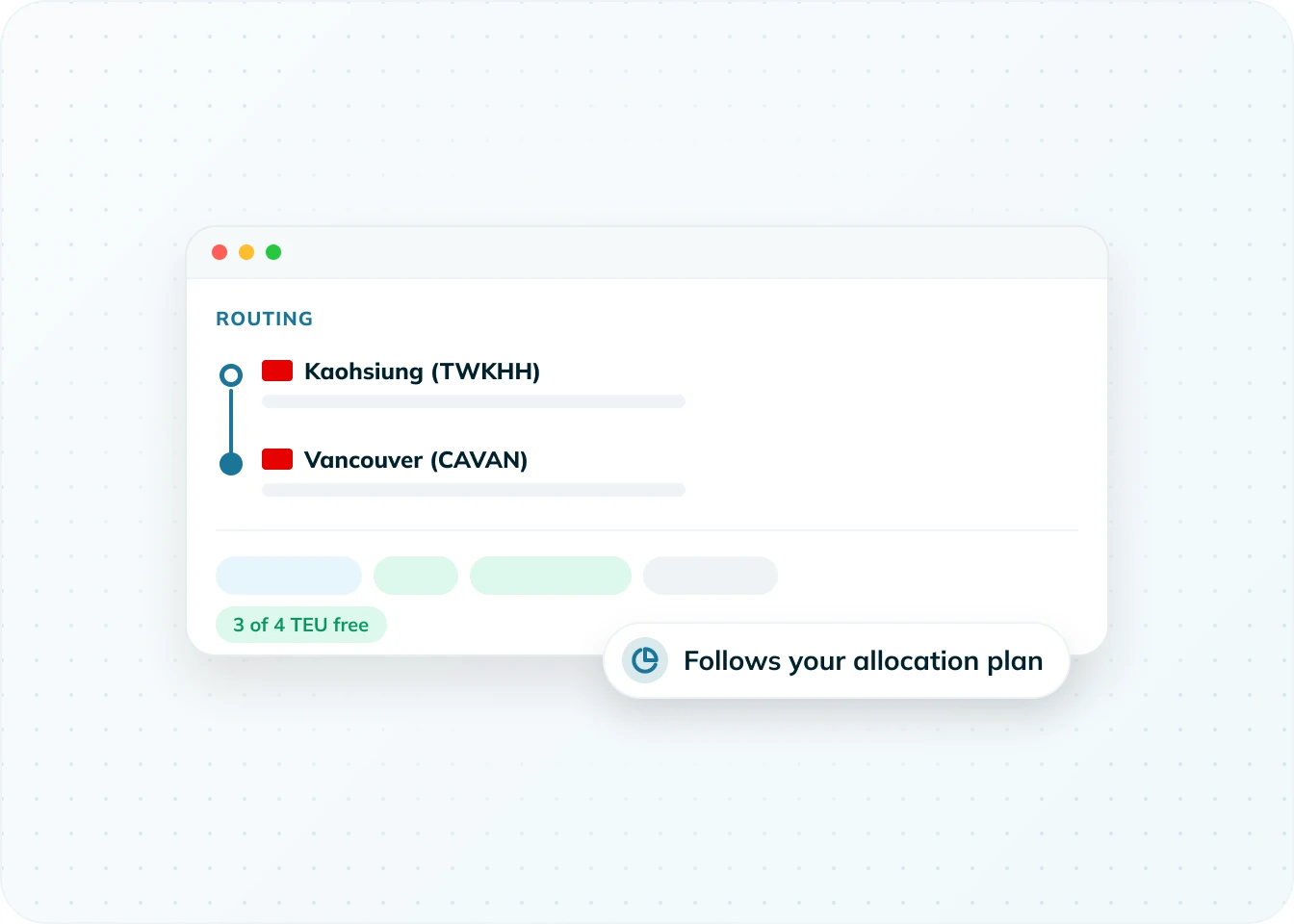
Allocation is agreed per contract period, often quarterly or yearly, but the person placing the booking rarely sees how actual use compares with the plan.
Planned allocation is part of the scoring, compared with actual use from the containers Portcast tracks. Carriers under their planned share rank higher, so operators follow the plan when they place blanket bookings weeks ahead of cargo readiness and when they finalize bookings closer to loading.
Contracted allocation used as planned, with less dead freight.
Booking under time pressure
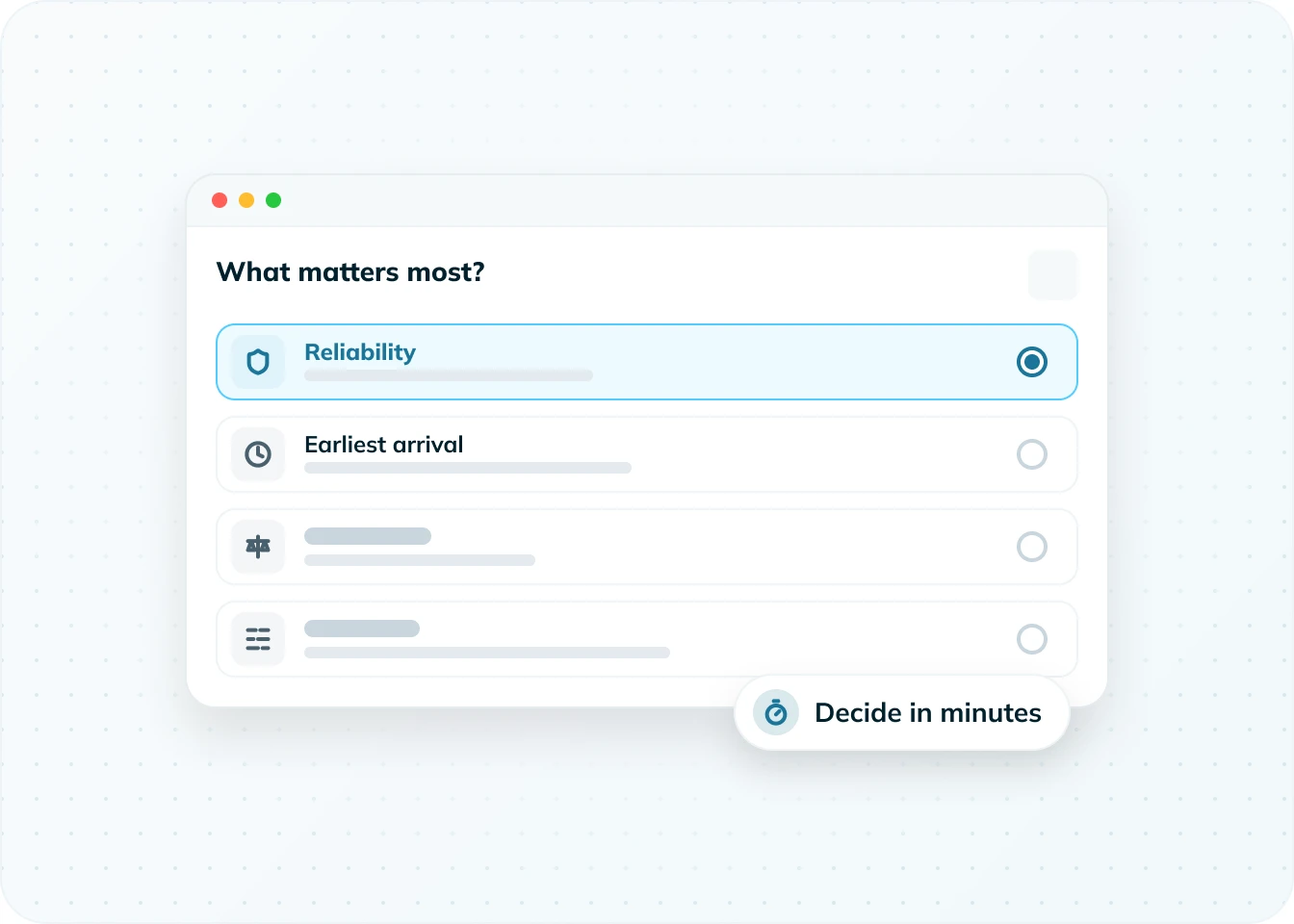
A booking has to go out today, and the evidence is spread across carrier sites, allocation sheets and rate files. With time for one or two checks, the decision leans on habit or gut feel.
The operator opens top recommendations that are already scored on live schedules, carrier and service-level reliability, price, allocation and disruption, with a plain-language reason for each. The decision takes minutes and still rests on the full data.
Quick decisions backed by deep data, with the operator in control.
How does Reef, the Routing Agent, work?



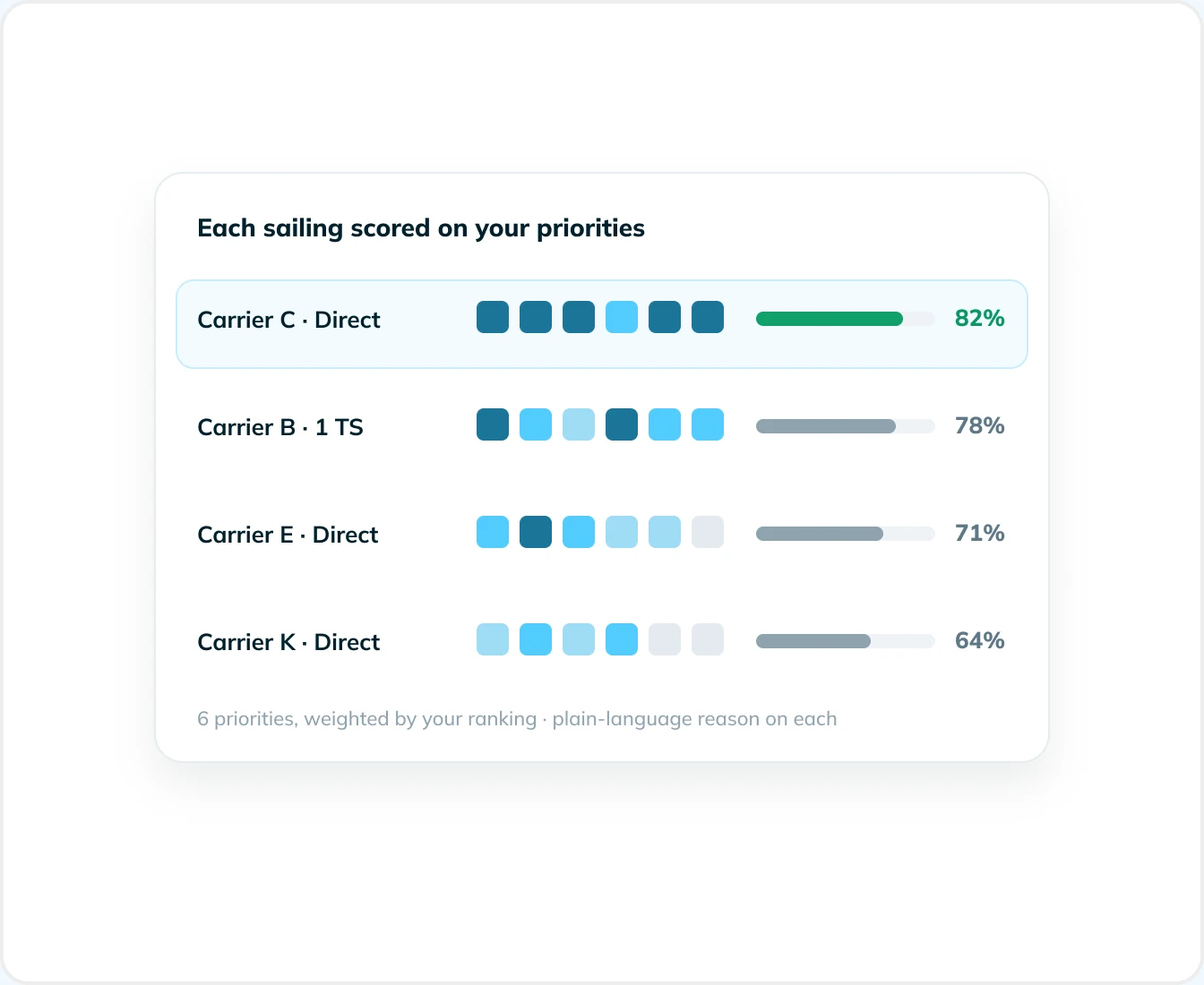

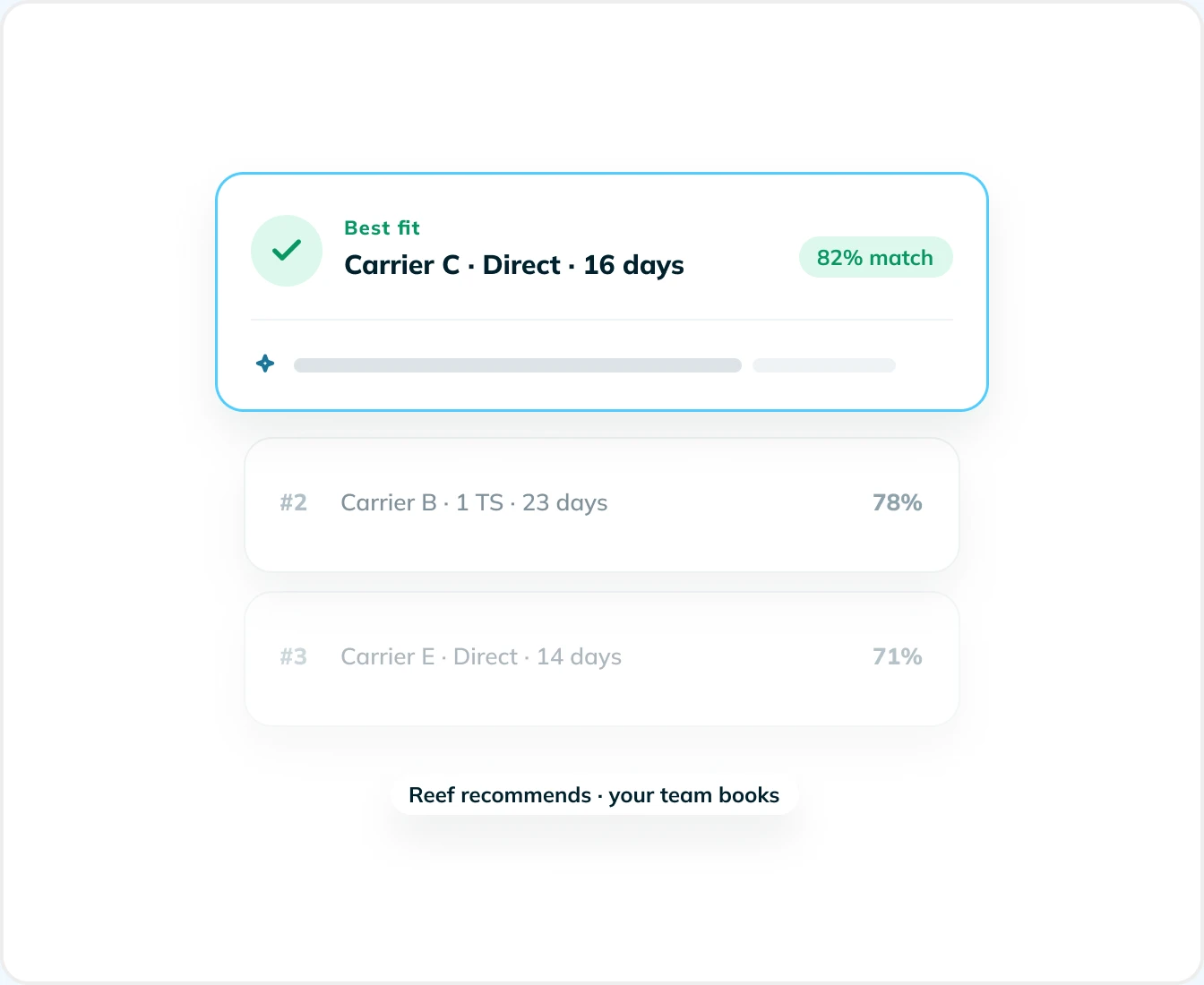
What does Reef
save in practice?
A leading global freight forwarder moves about 483,000 ocean containers a year and places blanket bookings with several carriers 3 to 4 weeks before cargo is ready. Across its lanes, Reef scores 40,000+ combinations in seconds, a comparison nearly impossible to do manually for every booking.
in estimated planner time reclaimed each year, across about 386,000 bookings.
in estimated value from a single retained key account.
of earlier warning on delayed bookings, while they can still be amended.
Planner time is valued at a $10 blended hourly rate and an estimated 10-minute reduction per booking, across about 386,000 bookings a year (about 483,000 containers). Further upside from catching slips earlier is not included.
What our customers say




Before, our team spent a lot of time checking different carrier websites and spreadsheets to figure out which sailing made the most sense. Now, we can compare our options much faster and spot potential delays before they become a bigger problem. It helps us make better booking decisions without losing time switching between sources.
How is Reef different from a sailing schedule tool or manual comparison?
A schedule tool shows what is available. Reef adds a scoring layer on top, so you see which sailing fits the booking and why.


How do Marina, Reef and Darya, Portcast’s AI agents, work together?
Three agents cover the life of a booking. Each one builds on the one before, and your team approves every step.
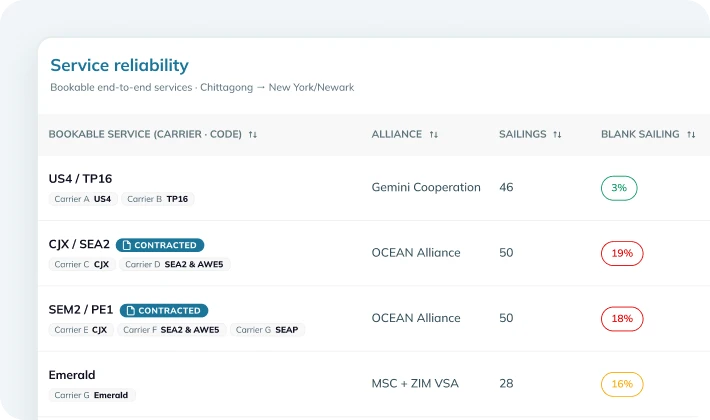
Marina
Benchmarks every carrier and bookable service on your lanes, so tenders, contracts and lead times start from delivered performance.
Explore Marina →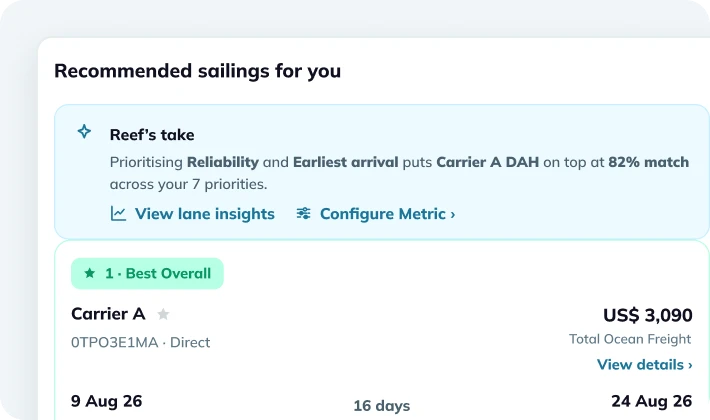
Reef
Ranks live sailings for the booking against your priorities, using carrier and service-level reliability data, and recommends the best fit.
Darya
Reviews every shipment overnight, ranks what needs attention, and flags when a booking needs a different sailing.
Explore Darya →What do teams ask most about Reef, the Routing Agent?
Any other question that isn’t mentioned? Don't hesitate to get in touch.
What is Reef, the Portcast Routing Agent?
How does Reef decide which sailing to book?
What data does Reef analyze?
Does Reef include transshipment routes?
How does Reef handle allocation agreements?
Can Reef help with rebooking after a rollover or a blank sailing?
Does Reef support alternate POL and POD pairs?
How current is the sailing schedule data behind Reef?
How is Reef different from a sailing schedule tool?
Does Reef book for us or replace our operators' judgment?
How does Reef work with Darya and Marina?
Does Reef work for both forwarders and cargo owners?
Can we embed Reef in our own booking platform?
What do we need to get started?




Still choosing sailings without comparing all the inputs?

 Book a demo

