The Company
A global third-party logistics provider moving approximately 500,000 ocean containers a year, roughly 41,000 a month, for large enterprise shippers and global consumer goods manufacturers, with 15 regional operators.
The Challenge
Carrier-by-carrier EDI could not support the visibility the company's new customer platform promised. Milestones arrived late and incomplete. Every new carrier added maintenance rather than leverage. Customers had no self-serve view, so every status question landed on an operator. And with free-time countdowns buried in carrier documents, demurrage and detention was quantified only after it had been incurred. In one case, a single container sitting in Singapore produced USD 300,000 in charges.
The Solution
Portcast's Command Center, white-labelled into the company's own portal with master and child accounts, so the team and its customers work from one branded view.
One consolidated source of truth
Direct integrations with 220+ ocean carriers, 400+ air carriers and 200+ terminals, cross-checked by independent sources. Terminal-sourced milestones arrive faster than EDI and hold accuracy through the final week before arrival.
Triage instead of lists
In a live view for one of their customers, with 5,500+ containers in view, the Command Center surfaces the fraction that actually need attention, so operators work the exceptions rather than the full book.
Live exception management, internal and external
Internal risk tracks what the journey is doing: rollovers, transshipment idling, missed connections, and slippage against the booked schedule. External risk tracks what the world is doing to it: weather and tropical storms, port congestion, strikes and port closures, and geopolitical events on the lane. Every card is configurable, with each team setting its own risk thresholds, board layout and alert triggers, so exceptions reach the operator before they reach the customer.
Demurrage and detention on the same board
Free days remaining and charges incurred sit alongside risk and delay, priced on negotiated buy-and-sell rates. Containers already accruing D&D charges surface in the same view, visible while they can still be worked rather than after the invoice lands.
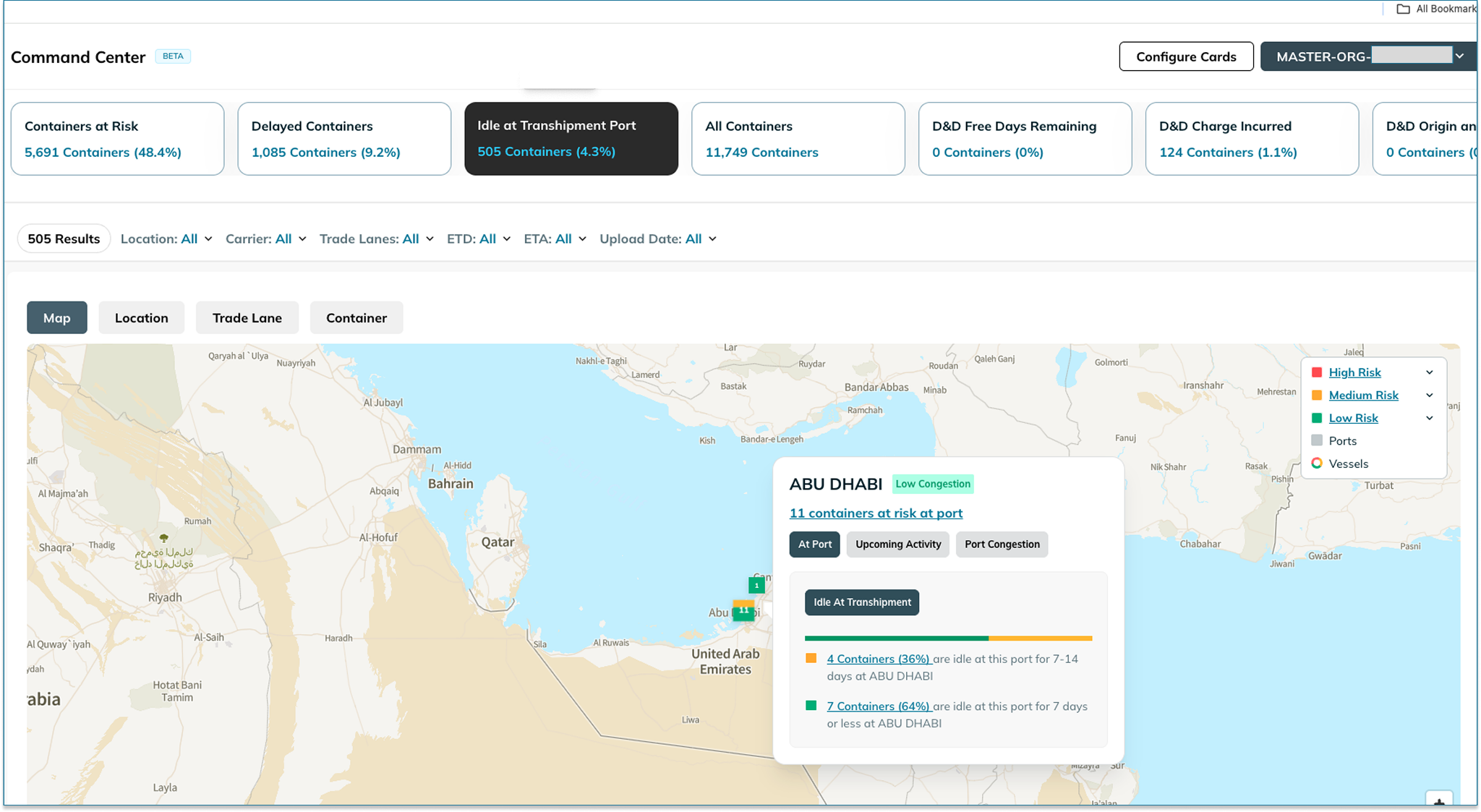
A snapshot from Portcast Command Center - Thousands of live containers sorted into a short list of what needs work, with D&D free days and charges shown alongside delay risk.
The Impact
Figures are based on the company's own volumes, team size and negotiated rates. Results vary with carrier mix, trade lanes and container volumes.
Curious how Portcast can cut manual tracking, improve shipment visibility, and reduce costs? Get in touch to explore how.