
It is 8:00 on a Monday. An operator sits down with a coffee, a dashboard, an inbox and three carrier portals, in front of a list of hundreds of active containers that all look equally important. Somewhere in that list, a vessel changed its port rotation overnight, a container has been idling at a transshipment hub for days, and free time on another is about to run out. Nobody knows which ones yet. Supply chain exception management is the work of finding those shipments before they turn into a customer call or a D&D invoice, and most teams do it the slow way. This is the story of where that work goes wrong, what it costs, and how a daily ranked brief from an AI agent changes the shape of the morning.
Why Do Supply Chain Visibility Problems Hide in the Gaps?
Many teams can see where a container is. The supply chain visibility problems that cost money sit in the gaps between the signals:
- Too many alerts. Standard alerts fire one rule at a time, so a busy day brings a flood of notifications and no view of which one comes first. Eventually, people treat them as noise, and the one that mattered gets ignored with the rest.
- Overnight changes found manually. The shipments that changed while the team was offline are the ones that need attention first, and they are the hardest to find.
- D&D found too late. Containers past free time are often spotted only after charges have already begun.
Visibility tells you where a shipment is. Actionability tells you which of hundreds to open first, and without it, priority goes to whoever escalates first, which is often the customer and often late.
What Does Reactive Exception Management in Logistics Cost?
The cost shows up in three places, and the first is time. Every morning spent rebuilding what changed is a morning not spent resolving it, across every operator on the desk.
The second is money. A last free day passes before the pickup is booked, and D&D appears on the invoice weeks later, after the cost is already sunk. Forwarders carry this exposure on behalf of their customers, so charges that start before anyone acts cut straight into margin. Acting while free time remains is the difference between avoiding a charge and absorbing it.
The third is trust. A rollover surfaces because a customer called to ask about it. A typhoon or a strike is in the news, and it takes hours to work out which containers are exposed. Each time, the customer learns about the problem before the team that is supposed to manage it.
What Should Logistics Tools for Proactive Exception Management Do?
The fix starts with a different question: what changed since yesterday, and what needs a decision today? Logistics tools for proactive exception management should be built around that question, and they should do six things:
- Rank by your own thresholds. Priorities should follow the rules your business sets, including lead-time limits, delay tolerance and customer SLAs.
- Detect what changed. The previous working day is the baseline, so overnight changes lead and improvements stay out.
- Explain and recommend. Every item shows its trigger and a suggested next step.
- Open into detail. One click leads to the containers, the map and the terminal milestones.
- Know about cost. Free time and D&D sit in the same ranking as delays.
- Keep people in control. The tool recommends and your team approves, with no automatic actions.
Meet Darya, an AI Agent for Supply Chain Operations That Works the Night Shift
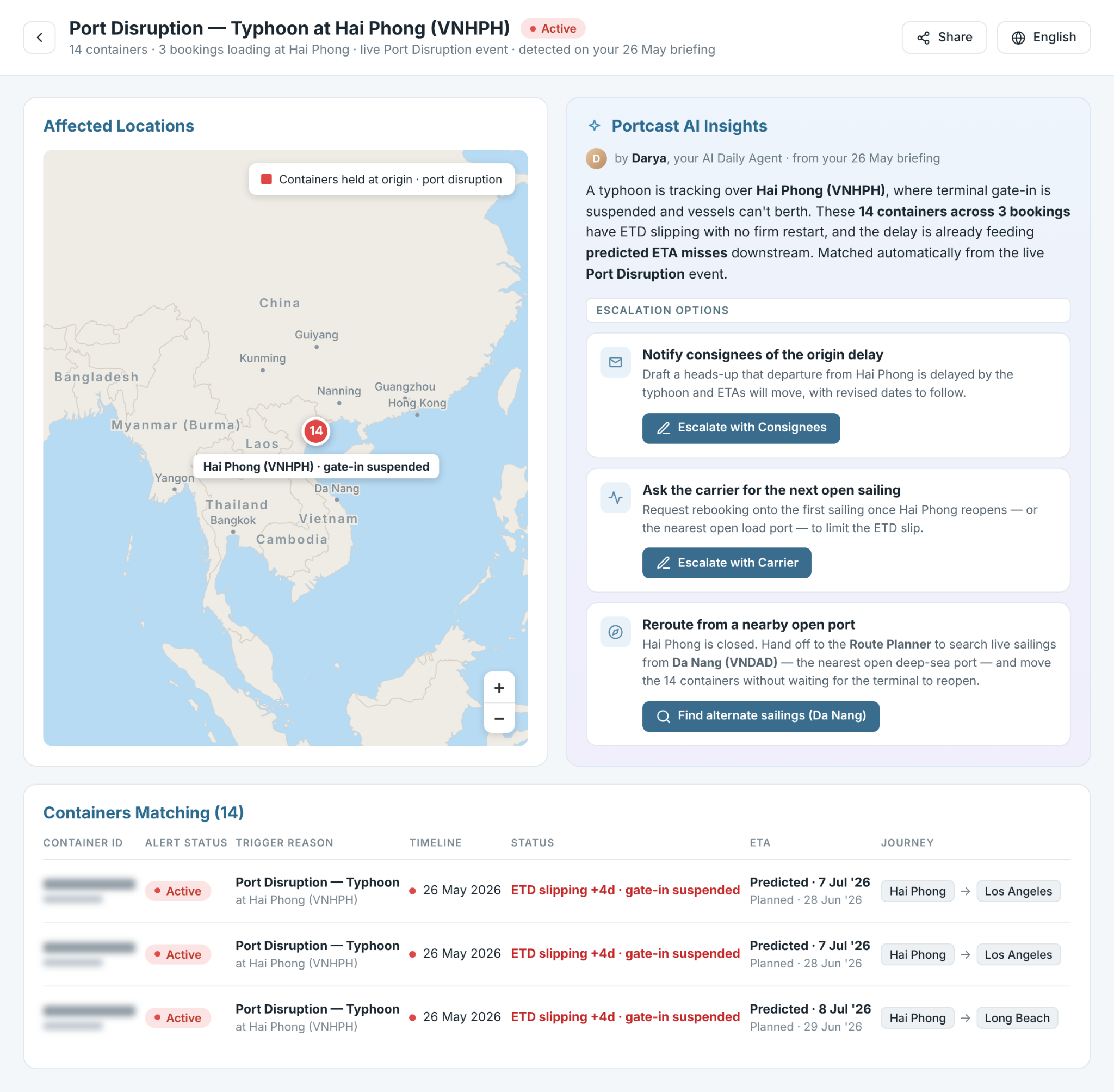
Darya is Portcast’s Daily Agent, an AI agent for supply chain operations. While your team is offline, Darya reviews every shipment against the previous working day, applies the thresholds your business set and filters out noise such as improvements. By the time the first operator logs in, each person has one ranked brief of the shipments they own. It shows what changed since yesterday, what needs a decision today and where risk and D&D are building, with the reason behind each item and a suggested next step.
This is AI for logistics operations in its most practical form: one morning routine that replaces the scan. Your team stays above the loop. Darya reviews and recommends, and your people decide.
What Does Darya Put in the Brief?
A ranked portfolio. Every active shipment is scored against your rules and ordered from the most urgent down: escalations first, then urgency, then business impact, including cost impact and customer SLAs. Prioritization follows the priorities your business has stated, so it does not depend on individual judgment under time pressure.
Overnight changes first. Late arrivals against contracted lead time, ETD slips at origin, unplanned transshipments, containers idling at transshipment ports, destination changes and port disruptions lead the brief. A rollover flag on a container whose ETA got better is suppressed, which keeps the focus on rolled containers that need attention.
Free time and D&D. Containers with free time expiring, and those already incurring charges, appear in the ranked list with a suggested next step, such as booking a haulier pickup or requesting a free-time extension.
The reason behind every flag. Each item shows its trigger, such as the new ETA against the contracted lead time and the days behind. When a disruption calls for rerouting, Darya flags the risk and Reef, the Routing Agent, can propose alternate sailings. Your team approves each step.
Every Item Opens in Command Center, Your Supply Chain Control Tower
The brief is where the day starts, and Command Center is where it continues. Every item is clickable. It opens straight into Command Center, on the card and thresholds you set up, and into container tracking, so your team moves from the daily update to the detail without searching.
Command Center is Portcast’s live supply chain control tower view. Risk cards surface the shipments that need attention, and an interactive map lets operators drill from a port or a vessel down to the affected containers. Early risk detection covers delayed departures, rollovers, port rotation changes, weather, strikes, port closures and geopolitical events, matched to your containers with impact windows. Each exception opens with the affected containers, a map and suggested next steps, and D&D running totals show where cost is building before invoices arrive.
Darya and Command Center share the same thresholds. Command Center is where your team sets and sees them, and Darya is how they turn into a morning routine.
What Do Teams Get Back?
One of Portcast’s customers, a global food manufacturer, uses Darya across 30,000+ containers a year and a team of 50 operators.
- Morning review dropped from hours to 10 minutes per operator, an estimated 80% faster start to the day.
- About 1,500 containers were flagged in time, which avoids about $300k in D&D charges each year.
- The time saved is worth about $190k in labor, or 152 hours back per operator.
These are Portcast estimates, with labor valued at a $25 blended hourly cost over 260 working days, and earlier disruption planning and stronger carrier escalations add further upside.
How Do Teams Get Started?
Setup builds on what you already have in Portcast. Your ocean shipments need to be tracked in Portcast with Command Center. Your team maps shipments to operators and confirms thresholds in Command Center, and each operator completes a short onboarding that sets role, company type and delivery time. D&D items appear for customers with the D&D module and contracts loaded.
Darya complements your alerts, and it does not replace them. The agent also does not replace your TMS or tracking system; it adds a prioritization layer and a morning brief to the tools your team already uses, and the brief is read-only, so your people approve every action.
Conclusion: Give the Morning Back to the People Who Run It
Supply chain exception management does not have to start with a scramble. When exceptions are found overnight, ranked against your own thresholds and handed to each operator with a reason and a next step, the morning stops being a search and becomes a list of decisions. Darya does that review every night, and every item opens in Command Center, so the operator goes from brief to detail in one click.
To see Darya working against your thresholds, talk to our team.
Frequently Asked Questions
What is supply chain exception management?
Supply chain exception management is detecting shipments that depart from plan, ranking them by urgency and business impact, and acting early. For ocean freight that covers delays against lead time, rollovers, unplanned transshipments, disruptions and free time running out. Tools such as Darya automate the overnight review and deliver a ranked brief.
What is an AI agent for supply chain operations?
An AI agent for supply chain operations reviews your shipment data, applies your rules and recommends next steps, while people stay in control. Darya, the Portcast Daily Agent, reviews every shipment overnight and gives each operator a ranked brief of what changed, what needs a decision and where D&D is building.
How does Darya decide which shipments to rank first?
Darya compares each container’s current state with the previous working day, including its leg and location, vessel, transshipment status and free time. It applies the thresholds your team set in Command Center, orders by escalations, urgency and business impact, and tunes the ranking to the operator’s role and company type.
How does Darya work with Command Center as a control tower?
Command Center is Portcast’s live control tower view, with risk cards, a map and the thresholds you set. Darya uses the same thresholds, and every item in the brief opens in Command Center and container tracking, so operators move from the brief to the affected containers and next steps in one click.
Does Darya take actions on its own?
No. Darya’s brief is read-only. It reviews, ranks and recommends, and each item opens in Command Center and container tracking so your team can act. Your people approve every action, including any rerouting that Reef proposes, so control stays with your operations team.